
- សិក្សាទៅតាមប៉ារ៉ាម៉ែត្រ ពីអត្ថិភាពឫស ទីតាំងឫសធៀបនឹងចំនួន និងចំនួនឫសនៃសមីការដឺក្រេទី 3 និងដឺក្រេទី 4 ដោយប្រើក្រាប
- ដោះស្រាយវិសមីការដឺក្រេទី 3 និងដឺក្រេទី 4 ដោយប្រើដេរីវេនិងក្រាប
- បង្ហាញវិសមីការដោយប្រើតារាងអថេរភាព ។
1. ការអនុវត្តដេរីវេចំពោះសមីការ
ចំនួនឫសនៃសមីការ \(\displaystyle f(x) = \lambda\) ស្មើនឹងចំនួនចំណុចប្រសព្វរវាងក្រាប \(\displaystyle C : y = f(x)\) និងបន្ទាត់ដេក \(\displaystyle D : y = \lambda\) ។ ដូច្នេះត្រូវសង់ក្រាបនៃ \(\displaystyle f\) សិន ហើយរំកិលបន្ទាត់ \(\displaystyle D\) ឡើងចុះ ។
1.1. សមីការដឺក្រេទី 3
ឧទាហរណ៍ : \(\displaystyle f(x) = x^3 + 3x^2 - 2\) មានក្រាប \(\displaystyle C\) ។ សិក្សាតាម \(\displaystyle \lambda\) ចំនួនឫសនៃ \(\displaystyle x^3 + 3x^2 - 2 = \lambda\) ។
\(\displaystyle f'(x) = 3x(x + 2) = 0\) ឱ្យ \(\displaystyle x = -2\) ឬ \(\displaystyle x = 0\) ។ \(\displaystyle f(-2) = 2\) ជាអតិបរមាធៀប ; \(\displaystyle f(0) = -2\) ជាអប្បបរមាធៀប ; \(\displaystyle \displaystyle\lim_{x\to\mp\infty}f = \mp\infty\) ។
| \(\displaystyle x\) | \(\displaystyle -\infty\) | \(\displaystyle -2\) | \(\displaystyle 0\) | \(\displaystyle +\infty\) | |||
| \(\displaystyle f'(x)\) | \(\displaystyle +\) | \(\displaystyle 0\) | \(\displaystyle -\) | \(\displaystyle 0\) | \(\displaystyle +\) | ||
| \(\displaystyle f(x)\) | \(\displaystyle -\infty\) | \(\displaystyle \nearrow\) | \(\displaystyle 2\) | \(\displaystyle \searrow\) | \(\displaystyle -2\) | \(\displaystyle \nearrow\) | \(\displaystyle +\infty\) |
ក្រាបកាត់អ័ក្ស \(\displaystyle y\) ត្រង់ \(\displaystyle -2\) ; កាត់អ័ក្ស \(\displaystyle x\) ត្រង់ \(\displaystyle (x+1)(x^2+2x-2) = 0\) គឺ \(\displaystyle x = -1, -1\pm\sqrt3\) ។
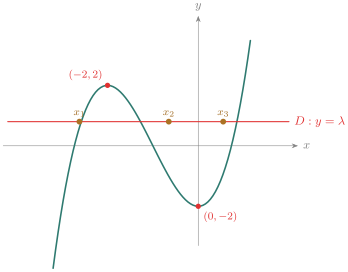
- \(\displaystyle \lambda > 2\) : មានឫស 1 ។
- \(\displaystyle \lambda = 2\) : មានឫសឌុប 1 និងឫសមួយទៀត (ឫសសរុប 2 ផ្សេងគ្នា) ។
- \(\displaystyle -2 < \lambda < 2\) : មានឫស 3 ផ្សេងគ្នា ។
- \(\displaystyle \lambda = -2\) : មានឫសឌុប 1 និងឫសមួយទៀត ។
- \(\displaystyle \lambda < -2\) : មានឫស 1 ។
សិក្សាតាម \(\displaystyle m\) អត្ថិភាពនិងទីតាំងឫសនៃ \(\displaystyle x^3 - 3x - m = 0\) ធៀបនឹង \(\displaystyle 0\) និង \(\displaystyle 1\) ។
សមីការសមមូល \(\displaystyle x^3 - 3x = m\) ។ ក្រាបនៃ \(\displaystyle y = x^3 - 3x\) មាន \(\displaystyle y' = 3(x-1)(x+1)\) ; អតិបរមា \(\displaystyle y(-1) = 2\) ; អប្បបរមា \(\displaystyle y(1) = -2\) ; កាត់អ័ក្ស \(\displaystyle x\) ត្រង់ \(\displaystyle 0, \pm\sqrt3\) ។
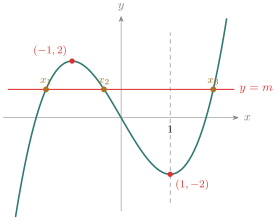
សន្មត \(\displaystyle x_1 \le x_2 \le x_3\) ជាឫស ៖
- \(\displaystyle m > 2\) : ឫសតែមួយ \(\displaystyle x_3\) ដែល \(\displaystyle 0 < 1 < x_3\) ។
- \(\displaystyle m = 2\) : \(\displaystyle x_1 = x_2 = -1 < 0 < 1 < x_3\) (\(\displaystyle x_3 = 2\)) ។
- \(\displaystyle 0 < m < 2\) : ឫសបីផ្សេងគ្នា \(\displaystyle x_1 < x_2 < 0 < 1 < x_3\) ។
- \(\displaystyle m = 0\) : ឫសបីផ្សេងគ្នា \(\displaystyle x_1 < x_2 = 0 < 1 < x_3\) (\(\displaystyle x = -\sqrt3, 0, \sqrt3\)) ។
- \(\displaystyle -2 < m < 0\) : ឫសបីផ្សេងគ្នា \(\displaystyle x_1 < 0 < x_2 < 1 < x_3\) ។
- \(\displaystyle m = -2\) : ឫសឌុប \(\displaystyle x_2 = x_3 = 1\) និងឫស \(\displaystyle x_1 = -2 < 0\) ព្រោះ \(\displaystyle x^3 - 3x + 2 = (x-1)^2(x+2)\) (សៀវភៅសរសេរថា «បីផ្សេងគ្នា» ជាកំហុស) ។
- \(\displaystyle m < -2\) : ឫសតែមួយ \(\displaystyle x_1 < 0 < 1\) ។
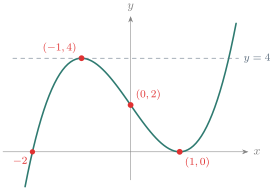
\(\displaystyle y = x^3 - 3x + 2\) មានក្រាប \(\displaystyle C\) ។ រក \(\displaystyle a\) ដើម្បីឱ្យ \(\displaystyle x^3 - 3x + 2 = a\) ក. មានឫសបីផ្សេងគ្នា ខ. មានឫសវិជ្ជមានពីរផ្សេងគ្នានិងឫសអវិជ្ជមានមួយ ។
មើលចម្លើយ
\(\displaystyle f(-1) = 4\) ; \(\displaystyle f(1) = 0\) ; \(\displaystyle f(0) = 2\) ។ ក. \(\displaystyle 0 < a < 4\) ។ ខ. \(\displaystyle 0 < a < 2\) (ពេល \(\displaystyle a = 2\) មានឫស \(\displaystyle 0\)) ។
1.2. សមីការដឺក្រេទី 4
ឧទាហរណ៍ : \(\displaystyle y = x^4 - 2x^2\) មានក្រាប \(\displaystyle C\) ។ សិក្សាតាម \(\displaystyle m\) ចំនួនឫសនៃ \(\displaystyle x^4 - 2x^2 - m = 0\) ។
\(\displaystyle y' = 4x(x - 1)(x + 1)\) ; អប្បបរមា \(\displaystyle y(\pm1) = -1\) ; អតិបរមា \(\displaystyle y(0) = 0\) ; \(\displaystyle \displaystyle\lim_{x\to\pm\infty}y = +\infty\) ; កាត់អ័ក្ស \(\displaystyle x\) ត្រង់ \(\displaystyle 0, \pm\sqrt2\) ។
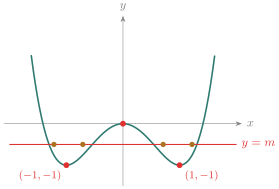
- \(\displaystyle m > 0\) : ឫស 2 ផ្សេងគ្នា ។
- \(\displaystyle m = 0\) : \(\displaystyle x^2(x^2 - 2) = 0\) មានឫស \(\displaystyle 0\) (ឌុប) និង \(\displaystyle \pm\sqrt2\) ។
- \(\displaystyle -1 < m < 0\) : ឫស 4 ផ្សេងគ្នា ។
- \(\displaystyle m = -1\) : ឫសឌុប 2 ត្រង់ \(\displaystyle x = \pm1\) ។
- \(\displaystyle m < -1\) : គ្មានឫស ។
\(\displaystyle f(x) = x^4 - 2x^2 + 2\) មានក្រាប \(\displaystyle C\) ។ សិក្សាតាម \(\displaystyle \lambda\) ទីតាំងឫសនៃ \(\displaystyle f(x) = \lambda\) ធៀបនឹង \(\displaystyle -1\) និង \(\displaystyle 1\) ។
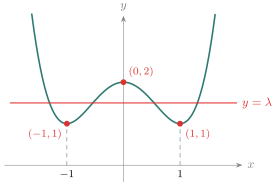
ក្រាបនេះគឺក្រាបនៃ \(\displaystyle y = x^4 - 2x^2\) រំកិលឡើង \(\displaystyle 2\) ឯកតា ដូច្នេះអប្បបរមា \(\displaystyle f(\pm1) = 1\) អតិបរមា \(\displaystyle f(0) = 2\) ។ សន្មត \(\displaystyle x_1 \le x_2 \le x_3 \le x_4\) ៖
- \(\displaystyle \lambda > 2\) : ឫសពីរផ្សេងគ្នា \(\displaystyle x_1 < -1 < 1 < x_2\) ។
- \(\displaystyle \lambda = 2\) : \(\displaystyle x_1 = -\sqrt2 < -1 < x_2 = x_3 = 0 < 1 < x_4 = \sqrt2\) ។
- \(\displaystyle 1 < \lambda < 2\) : ឫសបួនផ្សេងគ្នា \(\displaystyle x_1 < -1 < x_2 < x_3 < 1 < x_4\) ។
- \(\displaystyle \lambda = 1\) : \(\displaystyle x_1 = x_2 = -1 < x_3 = x_4 = 1\) ។
- \(\displaystyle \lambda < 1\) : គ្មានឫស ។
\(\displaystyle y = x^4 - 4x^2 + 3\) មានក្រាប ។ រក \(\displaystyle m\) ដើម្បីឱ្យ \(\displaystyle x^4 - 4x^2 = m - 3\) ក. មានឫសបួនផ្សេងគ្នា ខ. មានឫសពីរផ្សេងគ្នានៅក្រៅ \(\displaystyle [-2, 2]\) ។
មើលចម្លើយ
\(\displaystyle y(\pm\sqrt2) = -1\) ; \(\displaystyle y(0) = 3\) ; \(\displaystyle y(\pm2) = 3\) ។ ក. \(\displaystyle -1 < m < 3\) ។ ខ. \(\displaystyle m > 3\) ។
2. ការអនុវត្តដេរីវេចំពោះវិសមីការ
2.1. វិសមីការដឺក្រេទី 3
ឧទាហរណ៍ : បង្ហាញថា \(\displaystyle x^3 + x + 2 > 0\) ចំពោះ \(\displaystyle x > -1\) ។
របៀបទី 1 (ក្រាប) : \(\displaystyle y' = 3x^2 + 1 > 0\) ដូច្នេះ \(\displaystyle y\) កើនជានិច្ច ។ \(\displaystyle y = (x+1)(x^2 - x + 2)\) ហើយ \(\displaystyle x^2 - x + 2\) គ្មានឫសពិត ដូច្នេះកាត់អ័ក្ស \(\displaystyle x\) តែត្រង់ \(\displaystyle x = -1\) ។ ចំណុចដែល \(\displaystyle y > 0\) នៅលើអ័ក្ស \(\displaystyle x\) ត្រូវនឹង \(\displaystyle x > -1\) ។
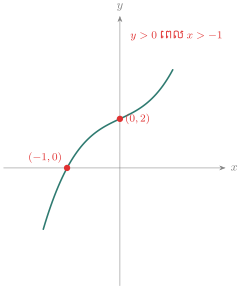
របៀបទី 2 (អថេរភាព) : \(\displaystyle y\) កើនលើ \(\displaystyle \mathbb{R}\) ហើយ \(\displaystyle y(-1) = 0\) ។ បើ \(\displaystyle x > -1\) នោះ \(\displaystyle y(x) > y(-1) = 0\) ។
\(\displaystyle f(x) = x^3 - 3x + 2\) មានក្រាប \(\displaystyle C\) ។ ក. ដោះស្រាយ \(\displaystyle x^3 - 3x + 2 < 0\) តាមក្រាប ។ ខ. បង្ហាញថា \(\displaystyle 0 \le x^3 - 3x + 2 \le 4\) ចំពោះ \(\displaystyle x \in [-2, 2]\) ។
\(\displaystyle f(x) = (x - 1)^2(x + 2)\) កាត់អ័ក្ស \(\displaystyle x\) ត្រង់ \(\displaystyle -2\) និងប៉ះត្រង់ \(\displaystyle 1\) ។ ក. ក្រាបនៅក្រោមអ័ក្ស \(\displaystyle x\) ពេល \(\displaystyle x < -2\) ដូច្នេះ \(\displaystyle S = (-\infty, -2)\) ។ ខ. តារាងអថេរភាពលើ \(\displaystyle [-2, 2]\) ៖
| \(\displaystyle x\) | \(\displaystyle -2\) | \(\displaystyle -1\) | \(\displaystyle 1\) | \(\displaystyle 2\) | |||
| \(\displaystyle f'(x)\) | \(\displaystyle +\) | \(\displaystyle 0\) | \(\displaystyle -\) | \(\displaystyle 0\) | \(\displaystyle +\) | ||
| \(\displaystyle f(x)\) | \(\displaystyle 0\) | \(\displaystyle \nearrow\) | \(\displaystyle 4\) | \(\displaystyle \searrow\) | \(\displaystyle 0\) | \(\displaystyle \nearrow\) | \(\displaystyle 4\) |
តម្លៃតូចបំផុតគឺ \(\displaystyle 0\) និងតម្លៃធំបំផុតគឺ \(\displaystyle 4\) ដូច្នេះ \(\displaystyle 0 \le f(x) \le 4\) ។
វិសមីការ \(\displaystyle P(x) > 0\) (ឬ \(\displaystyle < 0\)) មានសំណុំឫសជាអាប់ស៊ីសនៃចំណុចលើក្រាប \(\displaystyle y = P(x)\) ដែលនៅលើ (ឬក្រោម) អ័ក្ស \(\displaystyle x\) ។ អាចប្រើក្រាប ឬតារាងអថេរភាព ។
\(\displaystyle y = -x^3 + 3x - 2\) មានក្រាប \(\displaystyle C\) ។ ក. រកសំណុំឫសនៃ \(\displaystyle -x^3 + 3x - 2 \le 0\) ។ ខ. បង្ហាញថា \(\displaystyle -4 \le -x^3 + 3x - 2 \le 0\) ចំពោះ \(\displaystyle -1 \le x \le 2\) ។
មើលចម្លើយ
ក. \(\displaystyle -(x-1)^2(x+2) \le 0\) ឱ្យ \(\displaystyle x \in [-2, +\infty)\) ។ ខ. \(\displaystyle y(-1) = -4\) ; \(\displaystyle y(1) = 0\) ; \(\displaystyle y(2) = -4\) ដូច្នេះ \(\displaystyle -4 \le y \le 0\) ។
2.2. វិសមីការដែលអង្គទី 1 ជាកន្សោមប៊ីការេ
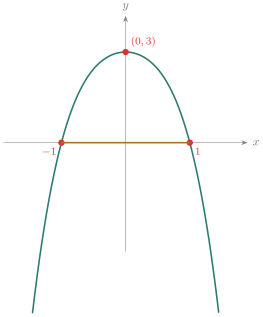
ឧទាហរណ៍ : ដោះស្រាយ \(\displaystyle -x^4 - 2x^2 + 3 \ge 0\) តាមក្រាប ។ \(\displaystyle y = -x^4 - 2x^2 + 3 = -(x^2 - 1)(x^2 + 3)\) មានអតិបរមា \(\displaystyle y(0) = 3\) ហើយកាត់អ័ក្ស \(\displaystyle x\) ត្រង់ \(\displaystyle \pm1\) ។ ក្រាបនៅលើអ័ក្ស \(\displaystyle x\) (ឬប៉ះ) ពេល \(\displaystyle -1 \le x \le 1\) ដូច្នេះ \(\displaystyle S = [-1, 1]\) ។
\(\displaystyle y = -\frac12x^4 + 3x^2 - \frac52\) មានក្រាប \(\displaystyle C\) ។ ក. ដោះស្រាយ \(\displaystyle y < 0\) ។ ខ. បង្ហាញថា \(\displaystyle 0 < y \le 2\) ចំពោះ \(\displaystyle x \in (-\sqrt5, -1) \cup (1, \sqrt5)\) ។
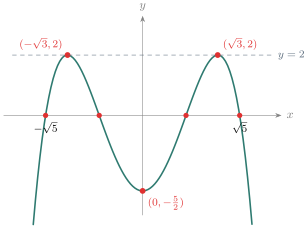
\(\displaystyle y = -\frac12(x^2 - 1)(x^2 - 5)\) មានអតិបរមា \(\displaystyle y(\pm\sqrt3) = 2\) និងអប្បបរមា \(\displaystyle y(0) = -\frac52\) ។ ក. ក្រាបនៅក្រោមអ័ក្ស \(\displaystyle x\) ពេល \(\displaystyle S = (-\infty, -\sqrt5) \cup (-1, 1) \cup (\sqrt5, +\infty)\) ។ ខ. លើ \(\displaystyle (-\sqrt5, -1) \cup (1, \sqrt5)\) ក្រាបនៅលើអ័ក្ស \(\displaystyle x\) ហើយមិនខ្ពស់ជាង \(\displaystyle y = 2\) ដូច្នេះ \(\displaystyle 0 < y \le 2\) ។
\(\displaystyle y = x^4 - 2x^2 + 1\) ។ ក. ដោះស្រាយ \(\displaystyle y > 0\) ។ ខ. បង្ហាញថា \(\displaystyle 0 \le y \le 1\) ចំពោះ \(\displaystyle x \in [-\sqrt2, \sqrt2]\) ។
មើលចម្លើយ
ក. \(\displaystyle y = (x^2 - 1)^2 > 0\) ឱ្យ \(\displaystyle x \in \mathbb{R}\setminus\{\pm1\}\) ។ ខ. \(\displaystyle y(\pm1) = 0\) ; \(\displaystyle y(0) = y(\pm\sqrt2) = 1\) ដូច្នេះ \(\displaystyle 0 \le y \le 1\) ។
លំហាត់
- \(\displaystyle y = x^3 - 3x^2\) មានក្រាប \(\displaystyle C\) ។ ក. សង់ក្រាប \(\displaystyle C\) ។ ខ. សិក្សាតាម \(\displaystyle m\) ចំនួនឫសនៃ \(\displaystyle x^3 - 3x^2 = m\) ។
- \(\displaystyle f(x) = x^3 - 6x + 5\) ។ ក. សង់ក្រាបនៃ \(\displaystyle f\) ។ ខ. សិក្សាតាម \(\displaystyle a\) អត្ថិភាពនិងសញ្ញាឫសនៃ \(\displaystyle x^3 - 6x + 5 - a = 0\) ។
- \(\displaystyle 2x^3 - 3x^2 - 12x - k = 0\) ។ ក. រក \(\displaystyle k\) ដើម្បីឱ្យមានឫសបីផ្សេងគ្នា ។ ខ. រក \(\displaystyle k\) ដើម្បីឱ្យមានឫសវិជ្ជមានពីរផ្សេងគ្នានិងឫសអវិជ្ជមានមួយ ។
- \(\displaystyle f(x) = x^3 - 3x + 1\) មានក្រាប \(\displaystyle C\) ។ ក. សង់ក្រាប \(\displaystyle C\) ។ ខ. សិក្សាតាម \(\displaystyle p\) អត្ថិភាពនិងទីតាំងឫសនៃ \(\displaystyle f(x) = p\) ធៀបនឹង \(\displaystyle -1\) និង \(\displaystyle 1\) ។
- ក. សង់ក្រាបនៃ \(\displaystyle y = \frac32x^4 + \frac12x^2 - 4\) ។ ខ. សិក្សាតាម \(\displaystyle m\) អត្ថិភាពនិងទីតាំងឫសនៃ \(\displaystyle \frac32x^4 + \frac12x^2 - 4 - m = 0\) ធៀបនឹង \(\displaystyle -1\) និង \(\displaystyle 2\) ។
- \(\displaystyle -2x^4 + 3x^2 - 1 = a\) ។ ក. រក \(\displaystyle a\) ដើម្បីឱ្យមានឫសបួនផ្សេងគ្នា ។ ខ. រក \(\displaystyle a\) ដើម្បីឱ្យគ្មានឫស ។
- ក. សង់ក្រាបនៃ \(\displaystyle f(x) = -\frac13x^3 + 2x^2 - 3x - 1\) ។ ខ. ដោះស្រាយ \(\displaystyle f(x) + 1 \le 0\) តាមក្រាប ។
- \(\displaystyle y = x^3 + 3x^2 - 4\) មានក្រាប \(\displaystyle C\) ។ ក. សង់ក្រាប \(\displaystyle C\) ។ ខ. បង្ហាញថា \(\displaystyle x^3 + 3x^2 - 4 \le 0\) ចំពោះ \(\displaystyle x \le -2\) ។
- \(\displaystyle y = \frac12x^4 + x^2 - \frac32\) មានក្រាប \(\displaystyle C\) ។ ក. ដោះស្រាយ \(\displaystyle y \ge 0\) តាមក្រាប ។ ខ. បង្ហាញថា \(\displaystyle y < 0\) ចំពោះ \(\displaystyle x \in (-1, 1)\) ។
- \(\displaystyle f(x) = -x^4 + 2x^2 - 2\) មានក្រាប \(\displaystyle C\) ។ ក. សង់ក្រាបនៃ \(\displaystyle f\) ។ ខ. ដោះស្រាយ \(\displaystyle -2 \le f(x) \le -1\) តាមក្រាបរួចតាមពីជគណិត ។ គ. បង្ហាញថា \(\displaystyle f(x) < -2\) ចំពោះ \(\displaystyle x \in (-\infty, -\sqrt2) \cup (\sqrt2, +\infty)\) ។
- ក. សង់ក្រាប \(\displaystyle C_1 : y = 3x^4 + 1\) និង \(\displaystyle C_2 : y = 8x^3 - 18x^2\) ក្នុងតម្រុយតែមួយ ។ ខ. បង្ហាញថា \(\displaystyle 3x^4 + 1 > 8x^3 - 18x^2\) ចំពោះ \(\displaystyle x \ge 0\) តាមក្រាប ។ គ. រកដេរីវេនៃ \(\displaystyle f(x) = 3x^4 - 8x^3 + 18x^2 + 1\) ហើយគណនា \(\displaystyle f(0)\) ។ ឃ. បង្ហាញថា \(\displaystyle f(x) > 0\) ចំពោះ \(\displaystyle x \ge 0\) ហើយទាញបញ្ជាក់វិសមីការខាងលើ ។
ចម្លើយលំហាត់
- \(\displaystyle f = x^3 - 3x^2\) មានអតិបរមា \(\displaystyle f(0) = 0\) អប្បបរមា \(\displaystyle f(2) = -4\) ។ \(\displaystyle m > 0\) : ឫស 1 ; \(\displaystyle m = 0\) : ឫសឌុប \(\displaystyle 0\) និងឫស \(\displaystyle 3\) ; \(\displaystyle -4 < m < 0\) : ឫស 3 ; \(\displaystyle m = -4\) : ឫសឌុប \(\displaystyle 2\) និងឫស \(\displaystyle -1\) ; \(\displaystyle m < -4\) : ឫស 1 ។
- អតិបរមា \(\displaystyle f(-\sqrt2) = 5 + 4\sqrt2\) ; អប្បបរមា \(\displaystyle f(\sqrt2) = 5 - 4\sqrt2\) ; \(\displaystyle f(0) = 5\) ។ \(\displaystyle a > 5 + 4\sqrt2\) : ឫសវិជ្ជមាន 1 ; \(\displaystyle a = 5 + 4\sqrt2\) : ឫសឌុប \(\displaystyle -\sqrt2\) និងឫសវិជ្ជមាន 1 ; \(\displaystyle 5 < a < 5 + 4\sqrt2\) : ឫសអវិជ្ជមាន 2 ឫសវិជ្ជមាន 1 ; \(\displaystyle a = 5\) : ឫសអវិជ្ជមាន 1, \(\displaystyle 0\), ឫសវិជ្ជមាន 1 ; \(\displaystyle 5 - 4\sqrt2 < a < 5\) : ឫសអវិជ្ជមាន 1 ឫសវិជ្ជមាន 2 ; \(\displaystyle a = 5 - 4\sqrt2\) : ឫសអវិជ្ជមាន 1 និងឫសឌុប \(\displaystyle \sqrt2\) ; \(\displaystyle a < 5 - 4\sqrt2\) : ឫសអវិជ្ជមាន 1 ។
- \(\displaystyle g = 2x^3 - 3x^2 - 12x\) : អតិបរមា \(\displaystyle g(-1) = 7\) ; អប្បបរមា \(\displaystyle g(2) = -20\) ។ ក. \(\displaystyle -20 < k < 7\) ខ. \(\displaystyle -20 < k < 0\)
- អតិបរមា \(\displaystyle f(-1) = 3\) ; អប្បបរមា \(\displaystyle f(1) = -1\) ។ \(\displaystyle p > 3\) : ឫស 1 (\(\displaystyle >1\)) ; \(\displaystyle p = 3\) : ឫសឌុប \(\displaystyle -1\) និងឫស \(\displaystyle 2\) ; \(\displaystyle -1 < p < 3\) : \(\displaystyle x_1 < -1 < x_2 < 1 < x_3\) ; \(\displaystyle p = -1\) : \(\displaystyle x_1 = -2\) និងឫសឌុប \(\displaystyle 1\) ; \(\displaystyle p < -1\) : ឫស 1 (\(\displaystyle < -2\)) ។
- ក. អប្បបរមា \(\displaystyle y(0) = -4\) ; \(\displaystyle y(\pm1) = -2\) ; \(\displaystyle y(\pm2) = 22\) ។ ខ. \(\displaystyle m < -4\) : គ្មានឫស ; \(\displaystyle m = -4\) : ឫសឌុប \(\displaystyle 0\) ; \(\displaystyle -4 < m < -2\) : \(\displaystyle -1 < x_1 < 0 < x_2 < 1\) ; \(\displaystyle m = -2\) : \(\displaystyle x_1 = -1, x_2 = 1\) ; \(\displaystyle -2 < m < 22\) : \(\displaystyle x_1 < -1\) និង \(\displaystyle 1 < x_2 < 2\) ; \(\displaystyle m = 22\) : \(\displaystyle x_1 = -2, x_2 = 2\) ; \(\displaystyle m > 22\) : \(\displaystyle x_1 < -2\) និង \(\displaystyle x_2 > 2\) ។
- អតិបរមា \(\displaystyle g\left(\pm\frac{\sqrt3}2\right) = \frac18\) ; អប្បបរមា \(\displaystyle g(0) = -1\) ។ ក. \(\displaystyle -1 < a < \frac18\) ខ. \(\displaystyle a > \frac18\)
- \(\displaystyle f(x) + 1 = -\frac13x(x - 3)^2 \le 0\) លុះត្រាតែ \(\displaystyle x \ge 0\) : \(\displaystyle S = [0, +\infty)\) ។
- \(\displaystyle x^3 + 3x^2 - 4 = (x - 1)(x + 2)^2 \le 0\) ចំពោះ \(\displaystyle x \le 1\) ដូច្នេះក៏ពិតចំពោះ \(\displaystyle x \le -2\) ។
- ក. \(\displaystyle y = \frac12(x^2 + 3)(x^2 - 1) \ge 0\) ឱ្យ \(\displaystyle x \in (-\infty, -1] \cup [1, +\infty)\) ខ. \(\displaystyle x^2 - 1 < 0\) ក្នុង \(\displaystyle (-1, 1)\) ដូច្នេះ \(\displaystyle y < 0\) ។
- ខ. \(\displaystyle f \le -1\) គ្រប់ \(\displaystyle x\) (អតិបរមា \(\displaystyle f(\pm1) = -1\)) ; \(\displaystyle f \ge -2\) លុះត្រាតែ \(\displaystyle x^2(2 - x^2) \ge 0\) ឱ្យ \(\displaystyle x \in [-\sqrt2, \sqrt2]\) ។ គ. \(\displaystyle f(x) < -2\) លុះត្រាតែ \(\displaystyle |x| > \sqrt2\) ។
- គ. \(\displaystyle f'(x) = 12x^3 - 24x^2 + 36x = 12x(x^2 - 2x + 3)\) ; \(\displaystyle f(0) = 1\) ។ ឃ. \(\displaystyle x^2 - 2x + 3 > 0\) ដូច្នេះ \(\displaystyle f' \ge 0\) ពេល \(\displaystyle x \ge 0\) : \(\displaystyle f\) កើន ហើយ \(\displaystyle f(x) \ge f(0) = 1 > 0\) ; ដោយ \(\displaystyle f(x) = (3x^4 + 1) - (8x^3 - 18x^2)\) គេបាន \(\displaystyle 3x^4 + 1 > 8x^3 - 18x^2\) ។
ខ្លឹមសារ៖ សៀវភៅពុម្ពគណិតវិទ្យាថ្នាក់ទី១១ របស់ក្រសួងអប់រំ យុវជន និងកីឡា · វាយអត្ថបទ គូររូបភាពឡើងវិញ និងរៀបចំលើអនឡាញដោយលោកគ្រូ សាន សុខលី សម្រាប់ការសិក្សាដោយឥតគិតថ្លៃ និងមិនរកប្រាក់ចំណេញ។ មិនមែនជាការបោះពុម្ពផ្លូវការរបស់ក្រសួងទេ។