
វត្ថុបំណង
1. សញ្ញាណនៃអនុគមន៍ជាប់
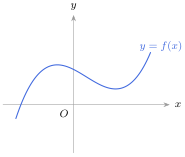
កាលណាគេគូសក្រាបនៃអនុគមន៍ \(\displaystyle y = f(x)\) លើចន្លោះ \(\displaystyle I\) មួយនៃដែនកំណត់ ដោយមិនលើកខ្មៅដៃ នោះគេបានគំនូសមួយដែលជាខ្សែ ដូចរូបខាងស្តាំ ។ គេថាអនុគមន៍ \(\displaystyle f\) ជាអនុគមន៍ជាប់ត្រង់គ្រប់ចំណុចនៃចន្លោះ \(\displaystyle I\) ។
2. ភាពជាប់ត្រង់មួយចំណុច
ឧទាហរណ៍ : គេមានអនុគមន៍
គេបាន \(\displaystyle f(0) = 0^2 + 7 = 7\)
- \(\displaystyle \lim_{x \to 0^+} f(x) = \lim_{x \to 0^+} (x^2 + 7) = 0^2 + 7 = 7\)
- \(\displaystyle \lim_{x \to 0^-} f(x) = \lim_{x \to 0^-} (x + 7) = 0 + 7 = 7\)
ដោយ \(\displaystyle \lim_{x \to 0^+} f(x) = \lim_{x \to 0^-} f(x) = 7 = f(0)\) ដូច្នេះ \(\displaystyle \lim_{x \to 0} f(x) = 7 = f(0)\) ។ គេថា \(\displaystyle f\) ជាអនុគមន៍ជាប់ត្រង់ \(\displaystyle x = 0\) ។
និយមន័យ : អនុគមន៍ \(\displaystyle y = f(x)\) ជាប់ត្រង់ចំណុច \(\displaystyle x = c\) កាលណា \(\displaystyle f\) បំពេញលក្ខខណ្ឌទាំងបីដូចខាងក្រោម ៖
- \(\displaystyle f\) កំណត់ចំពោះ \(\displaystyle x = c\)
- \(\displaystyle f\) មានលីមីតកាលណា \(\displaystyle x \to c\)
- \(\displaystyle \lim_{x \to c} f(x) = f(c)\) ។
សម្គាល់ : បើអនុគមន៍ \(\displaystyle y = f(x)\) មិនជាប់ត្រង់ចំណុច \(\displaystyle x = c\) គេថា \(\displaystyle f\) ជាអនុគមន៍ដាច់ត្រង់ \(\displaystyle x = c\) ។
លំហាត់គំរូ 1 :
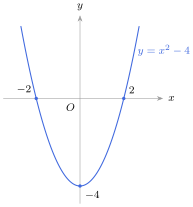
- ក. អនុគមន៍ \(\displaystyle f\) កំណត់ដោយ \(\displaystyle f(x) = x^2 - 4\) ។ តើ \(\displaystyle f\) ជាអនុគមន៍ជាប់ត្រង់ \(\displaystyle x = 2\) ឬទេ ?
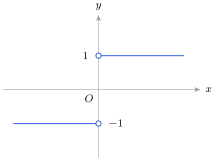
- ខ. អនុគមន៍ \(\displaystyle g\) កំណត់ដោយ \(\displaystyle g(x) = \begin{cases} -1 & \text{បើ } x < 0 \\ 1 & \text{បើ } x > 0 \end{cases}\) ។ តើ \(\displaystyle g\) ជាអនុគមន៍ជាប់ត្រង់ \(\displaystyle x = 0\) ឬទេ ?
ដំណោះស្រាយ :
- ក.
ត្រង់ \(\displaystyle x = 2\) នាំឱ្យ \(\displaystyle f(2) = 2^2 - 4 = 0\) ហើយ \(\displaystyle \lim_{x \to 2} f(x) = \lim_{x \to 2} (x^2 - 4) = 0\) គេបាន \(\displaystyle \lim_{x \to 2} f(x) = f(2) = 0\) ។ ដូច្នេះ អនុគមន៍ \(\displaystyle f\) ជាប់ត្រង់ \(\displaystyle x = 2\) ។
- ខ.
\(\displaystyle \lim_{x \to 0^-} g(x) = -1\) និង \(\displaystyle \lim_{x \to 0^+} g(x) = 1\) លីមីតឆ្វេងមិនស្មើលីមីតស្តាំ អនុគមន៍ \(\displaystyle g\) គ្មានលីមីតត្រង់ \(\displaystyle x = 0\) ទេ ។ ដូច្នេះ អនុគមន៍ \(\displaystyle g\) ដាច់ត្រង់ \(\displaystyle x = 0\) ។
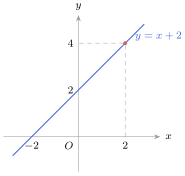
លំហាត់គំរូ 2 : គេមានអនុគមន៍ \(\displaystyle f(x) = \begin{cases} \dfrac{x^2 - 4}{x - 2} & \text{បើ } x \neq 2 \\ 4 & \text{បើ } x = 2 \end{cases}\) ។ បង្ហាញថា \(\displaystyle f\) ជាអនុគមន៍ជាប់ត្រង់ \(\displaystyle x = 2\) ។
ដំណោះស្រាយ : \(\displaystyle f\) កំណត់ត្រង់ \(\displaystyle x = 2\) ហើយ \(\displaystyle f(2) = 4\) ។ \(\displaystyle \lim_{x \to 2} f(x) = \lim_{x \to 2} \dfrac{x^2 - 4}{x - 2} = \lim_{x \to 2} (x + 2) = 4 = f(2)\) ដូច្នេះ \(\displaystyle f\) ជាអនុគមន៍ជាប់ត្រង់ \(\displaystyle 2\) ។
ប្រតិបត្តិ :
- ក. សង់ក្រាបនៃ \(\displaystyle f(x) = \begin{cases} 3 + x & \text{បើ } x \le 1 \\ 3 - x & \text{បើ } x > 1 \end{cases}\) ។ សិក្សាភាពជាប់នៃ \(\displaystyle f\) នៅត្រង់ \(\displaystyle x = 1\) ។
- ខ. សង់ក្រាបនៃ \(\displaystyle g(x) = \begin{cases} \sin x & \text{បើ } x \ge 0 \\ \dfrac{1}{2}x^2 + x & \text{បើ } x < 0 \end{cases}\) ។ តើ \(\displaystyle g\) ជាប់នៅត្រង់ \(\displaystyle x = 0\) ឬទេ ?
ចម្លើយ : ក. \(\displaystyle f\) មិនជាប់ត្រង់ \(\displaystyle x = 1\) ខ. \(\displaystyle g\) ជាប់ត្រង់ \(\displaystyle x = 0\) ។
3. លក្ខណៈនៃអនុគមន៍ជាប់
ផ្អែកតាមលក្ខណៈនៃលីមីតនិងនិយមន័យភាពជាប់ គេបានលក្ខណៈនៃអនុគមន៍ជាប់ដូចខាងក្រោម ៖
បើអនុគមន៍ \(\displaystyle f\) និង \(\displaystyle g\) ជាប់ត្រង់ \(\displaystyle x = c\) នោះ គេបាន
- \(\displaystyle f(x) + g(x)\) ជាអនុគមន៍ជាប់ត្រង់ \(\displaystyle x = c\)
- \(\displaystyle f(x) - g(x)\) ជាអនុគមន៍ជាប់ត្រង់ \(\displaystyle x = c\)
- \(\displaystyle f(x) \cdot g(x)\) ជាអនុគមន៍ជាប់ត្រង់ \(\displaystyle x = c\)
- \(\displaystyle kf(x)\) ជាអនុគមន៍ជាប់ត្រង់ \(\displaystyle x = c\) (ដែល \(\displaystyle k\) ជាចំនួនថេរ)
- \(\displaystyle \dfrac{f(x)}{g(x)}\) ជាប់ត្រង់ \(\displaystyle x = c\) ដែល \(\displaystyle g(c) \neq 0\) ។
ដោយប្រើលក្ខណៈនៃលីមីតនិងលក្ខណៈនៃអនុគមន៍ជាប់ គេបាន
- អនុគមន៍លីនេអ៊ែរ ជាអនុគមន៍ជាប់ចំពោះគ្រប់ចំនួនពិត ។
- អនុគមន៍ពហុធា \(\displaystyle P\) ដែលមានដឺក្រេ \(\displaystyle n\) : \(\displaystyle P(x) = a_0 x^n + a_1 x^{n-1} + a_2 x^{n-2} + \dots + a_n\) ដែល \(\displaystyle a_1, a_2, a_3, \dots, a_n\) ជាចំនួនថេរនិង \(\displaystyle a_0 \neq 0\) ជាអនុគមន៍ជាប់គ្រប់តម្លៃ \(\displaystyle x\) ។ តាមទ្រឹស្តីបទនៃលីមីតពហុធាបង្ហាញថា បើ \(\displaystyle c\) ជាចំនួនពិត គេបាន \(\displaystyle \lim_{x \to c} P(x) = a_0 c^n + a_1 c^{n-1} + a_2 c^{n-2} + \dots + a_n = P(c)\) ដូច្នេះ \(\displaystyle \lim_{x \to c} P(x) = P(c)\) នាំឱ្យអនុគមន៍ពហុធាជាអនុគមន៍ជាប់គ្រប់តម្លៃ \(\displaystyle x\) ។
- អនុគមន៍សនិទាន \(\displaystyle R(x) = \dfrac{p(x)}{q(x)}\), \(\displaystyle q(x) \neq 0\) ។ ដោយ \(\displaystyle p\) និង \(\displaystyle q\) ជាអនុគមន៍ពហុធាជាប់ត្រង់ \(\displaystyle c\) \(\displaystyle \lim_{x \to c} p(x) = p(c)\) និង \(\displaystyle \lim_{x \to c} q(x) = q(c)\) គេបាន \(\displaystyle \lim_{x \to c} R(x) = \dfrac{p(c)}{q(c)}\) ។ ដូច្នេះ អនុគមន៍សនិទានជាប់គ្រប់តម្លៃ \(\displaystyle x\) ដែល \(\displaystyle q(x) \neq 0\) ។
- អនុគមន៍រ៉ាឌីកាល់ \(\displaystyle f(x) = \sqrt[n]{x}\) ជាអនុគមន៍ជាប់ត្រង់តម្លៃ \(\displaystyle x\) ក្នុងដែនកំណត់ ។
- អនុគមន៍ត្រីកោណមាត្រ \(\displaystyle y = \sin x\), \(\displaystyle y = \cos x\) ជាអនុគមន៍ជាប់ចំពោះគ្រប់ចំនួនពិត ។
- អនុគមន៍ \(\displaystyle y = \tan x\) ជាអនុគមន៍ជាប់ចំពោះគ្រប់ \(\displaystyle x \in \mathbb{R}\) និង \(\displaystyle x \neq (2k + 1)\dfrac{\pi}{2}\), \(\displaystyle k \in \mathbb{Z}\) ។
- អនុគមន៍ \(\displaystyle y = \cot x\) ជាអនុគមន៍ជាប់ចំពោះគ្រប់ \(\displaystyle x \in \mathbb{R}\) និង \(\displaystyle x \neq k\pi\), \(\displaystyle k \in \mathbb{Z}\) ។
លំហាត់គំរូ 1 : រកតម្លៃនៃ \(\displaystyle x\) ដែលនាំឱ្យអនុគមន៍ខាងក្រោម ជាអនុគមន៍ជាប់ ។
- ក. \(\displaystyle f(x) = x^{14} + 20x^4\)
- ខ. \(\displaystyle g(x) = (7x^2 + 8)(3 - x)\)
- គ. \(\displaystyle h(x) = \dfrac{x + 3}{x^2 - 3x - 10}\) ។
ដំណោះស្រាយ :
- ក. ដោយ \(\displaystyle x^{14}\) និង \(\displaystyle 20x^4\) ជាប់គ្រប់តម្លៃ \(\displaystyle x\) នោះតាមលក្ខណៈ 1 គេបាន \(\displaystyle f(x) = x^{14} + 20x^4\) ជាប់គ្រប់តម្លៃ \(\displaystyle x\) ។
- ខ. ដោយ \(\displaystyle (7x^2 + 8)\) និង \(\displaystyle (3 - x)\) ជាអនុគមន៍ពហុធាជាប់គ្រប់តម្លៃ \(\displaystyle x\) នោះតាមលក្ខណៈ 3 គេបាន \(\displaystyle g(x) = (7x^2 + 8)(3 - x)\) ជាប់គ្រប់តម្លៃ \(\displaystyle x\) ។
- គ. គេបាន \(\displaystyle h(x) = \dfrac{x + 3}{x^2 - 3x - 10} = \dfrac{x + 3}{(x - 5)(x + 2)}\) ជាអនុគមន៍សនិទាន ។ តាមលក្ខណៈ 5 ដោយ \(\displaystyle y = x + 3\) និង \(\displaystyle y = (x - 5)(x + 2)\) ជាប់គ្រប់តម្លៃ \(\displaystyle x\) ហើយ \(\displaystyle (x - 5)(x + 2) = 0\) សមមូល \(\displaystyle x = 5\) ឬ \(\displaystyle x = -2\) អនុគមន៍ \(\displaystyle h\) ជាប់គ្រប់តម្លៃ \(\displaystyle x\) លើកលែងតែ \(\displaystyle x = 5\) និង \(\displaystyle x = -2\) ។
លំហាត់គំរូ 2 : បង្ហាញថា \(\displaystyle y = f(x) = \begin{cases} \dfrac{\sin x}{x} & \text{បើ } x \neq 0 \\ 1 & \text{បើ } x = 0 \end{cases}\) ជាអនុគមន៍ជាប់ចំពោះគ្រប់ចំនួនពិត ។
ដំណោះស្រាយ : ដោយ \(\displaystyle y = \sin x\) និង \(\displaystyle y = x\) ជាអនុគមន៍ជាប់ចំពោះគ្រប់ \(\displaystyle x \in \mathbb{R}\) នោះគេបាន \(\displaystyle y = \dfrac{\sin x}{x}\) ជាអនុគមន៍ជាប់ចំពោះ \(\displaystyle x \neq 0\) ។ គេមាន \(\displaystyle f(0) = 1\) និង \(\displaystyle \lim_{x \to 0} f(x) = \lim_{x \to 0} \dfrac{\sin x}{x} = 1 = f(0)\) ។ ដូច្នេះ អនុគមន៍ \(\displaystyle f\) ជាប់ត្រង់ \(\displaystyle x = 0\) នាំឱ្យអនុគមន៍ \(\displaystyle f\) ជាប់ ចំពោះគ្រប់ចំនួនពិត ។
លំហាត់គំរូ 3 : រកតម្លៃ \(\displaystyle a\) ដែលធ្វើឱ្យអនុគមន៍ \(\displaystyle f(x) = \begin{cases} 3x - a & \text{បើ } x \le 1 \\ \dfrac{x^2 - 3x + 2}{x - 1} & \text{បើ } x > 1 \end{cases}\) ជាប់ត្រង់ \(\displaystyle x = 1\) ។
ដំណោះស្រាយ : បើ \(\displaystyle f(x)\) ជាអនុគមន៍ជាប់ត្រង់ \(\displaystyle x = 1\) នោះ \(\displaystyle \lim_{x \to 1^+} f(x) = \lim_{x \to 1^-} f(x)\) ។ គេបាន \(\displaystyle \lim_{x \to 1^+} \dfrac{x^2 - 3x + 2}{x - 1} = \lim_{x \to 1^-} (3x - a) = 3(1) - a = 3 - a\) ដូច្នេះ \(\displaystyle 3 - a = \lim_{x \to 1^+} \dfrac{x^2 - 3x + 2}{x - 1} = \lim_{x \to 1^+} \dfrac{(x - 2)(x - 1)}{x - 1} = \lim_{x \to 1^+} (x - 2) = 1 - 2 = -1\) \(\displaystyle 3 - a = -1\) នាំឱ្យ \(\displaystyle a = 4\) ។
ប្រតិបត្តិ 1 : បង្ហាញថាអនុគមន៍ខាងក្រោម ជាអនុគមន៍ជាប់ចំពោះគ្រប់ \(\displaystyle x\) នៃដែនកំណត់របស់វា ។
- ក. \(\displaystyle f(x) = x^4\left(x + \dfrac{1}{3}\right)^2\)
- ខ. \(\displaystyle g(x) = \dfrac{x^2 - 3x + 1}{x^2 - 4x + 3}\) ។
ប្រតិបត្តិ 2 : កំណត់តម្លៃ \(\displaystyle a\) ដែលនាំឱ្យអនុគមន៍ខាងក្រោមជាប់ត្រង់ \(\displaystyle x = 0\) ។ \(\displaystyle f(x) = \begin{cases} -x + a & \text{បើ } x < 0 \\ x^2 - 1 & \text{បើ } x \ge 0 \end{cases}\)
ចម្លើយ : \(\displaystyle a = -1\) ។
4. ភាពជាប់លើចន្លោះ
ឧទាហរណ៍ 1 : គេមានអនុគមន៍ \(\displaystyle f(x) = \dfrac{2}{x + 5}\) ។ អនុគមន៍ \(\displaystyle f\) កំណត់កាលណា \(\displaystyle x \neq -5\) ។ ដែនកំណត់នៃអនុគមន៍ \(\displaystyle f\) គឺ \(\displaystyle D = (-\infty, -5) \cup (-5, +\infty)\) ។ \(\displaystyle f\) ជាអនុគមន៍សនិទាន \(\displaystyle f\) ជាប់គ្រប់តម្លៃ \(\displaystyle x \in (-\infty, -5)\) និងគ្រប់ \(\displaystyle x \in (-5, +\infty)\) ។ គេថាអនុគមន៍ \(\displaystyle f\) ជាប់លើចន្លោះបើក \(\displaystyle (-\infty, -5)\) និងជាប់លើចន្លោះបើក \(\displaystyle (-5, +\infty)\) ។
ឧទាហរណ៍ 2 : សិក្សាភាពជាប់នៃអនុគមន៍ \(\displaystyle g(x) = \begin{cases} 5 - x & \text{បើ } -1 \le x \le 2 \\ x^2 - 1 & \text{បើ } 2 < x \le 3 \end{cases}\) ។
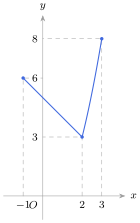
គេមាន \(\displaystyle 5 - x\) និង \(\displaystyle x^2 - 1\) ជាអនុគមន៍ពហុធា ។ តាមលក្ខណៈខាងលើ \(\displaystyle y = 5 - x\) ជាប់គ្រប់ \(\displaystyle x \in (-1, 2)\) ហើយ \(\displaystyle y = x^2 - 1\) ជាប់គ្រប់ \(\displaystyle x \in (2, 3)\) ។ \(\displaystyle \lim_{x \to 2^-} g(x) = \lim_{x \to 2^-} (5 - x) = 3\) និង \(\displaystyle \lim_{x \to 2^+} g(x) = \lim_{x \to 2^+} (x^2 - 1) = 3\) លីមីតទាំងពីរស្មើគ្នា ហើយ \(\displaystyle \lim_{x \to 2} g(x) = g(2) = 3\) ។ ដូច្នេះ \(\displaystyle g\) ជាអនុគមន៍ជាប់ត្រង់ \(\displaystyle x = 2\) ។ គេថា \(\displaystyle g\) ជាប់លើចន្លោះបើក \(\displaystyle (-1, 3)\) ហើយមាន \(\displaystyle \lim_{x \to -1^+} g(x) = \lim_{x \to -1^+} (5 - x) = g(-1) = 6\) និង \(\displaystyle \lim_{x \to 3^-} g(x) = \lim_{x \to 3^-} (x^2 - 1) = g(3) = 8\) គេថា \(\displaystyle g\) ជាប់លើចន្លោះបិទ \(\displaystyle [-1, 3]\) ។
និយមន័យ :
- អនុគមន៍ \(\displaystyle f\) ជាប់លើចន្លោះបើក \(\displaystyle (a, b)\) លុះត្រាតែ \(\displaystyle f\) ជាប់ចំពោះគ្រប់តម្លៃ \(\displaystyle x\) នៃចន្លោះបើកនោះ ។
- អនុគមន៍ \(\displaystyle f\) ជាប់លើចន្លោះបិទ \(\displaystyle [a, b]\) លុះត្រាតែ \(\displaystyle f\) ជាប់លើចន្លោះបើក \(\displaystyle (a, b)\) និងមានលីមីត \(\displaystyle \lim_{x \to a^+} f(x) = f(a)\) និង \(\displaystyle \lim_{x \to b^-} f(x) = f(b)\) ។ (អនុគមន៍ \(\displaystyle f\) ជាប់ត្រង់ \(\displaystyle a\) ខាងស្តាំ ជាប់ត្រង់ \(\displaystyle b\) ខាងឆ្វេង)
លំហាត់គំរូ 1 : សិក្សាភាពជាប់នៃអនុគមន៍ \(\displaystyle f(x) = \dfrac{x + 2}{x - 3}\) លើចន្លោះ \(\displaystyle (-2, 3)\) និង \(\displaystyle [-2, 3]\) ។
ដំណោះស្រាយ : គេបានអនុគមន៍ \(\displaystyle f(x) = \dfrac{x + 2}{x - 3}\) ជាអនុគមន៍សនិទាន នាំឱ្យ \(\displaystyle f(x)\) ជាប់គ្រប់តម្លៃ \(\displaystyle x\) លើកលែង \(\displaystyle x = 3\) ។ ដូច្នេះ គេថាអនុគមន៍ \(\displaystyle f\) ជាប់លើចន្លោះបើក \(\displaystyle (-2, 3)\) ប៉ុន្តែមិនជាប់លើចន្លោះបិទ \(\displaystyle [-2, 3]\) ទេ ព្រោះអនុគមន៍មិនកំណត់ត្រង់ \(\displaystyle x = 3\) ។
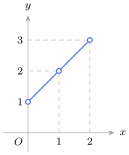
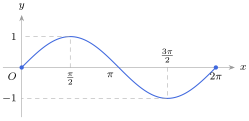
លំហាត់គំរូ 2 : សង់ក្រាបនៃអនុគមន៍ទាំងបីខាងក្រោម រួចបញ្ជាក់ភាពជាប់លើចន្លោះដែលឱ្យ ។
- ក. \(\displaystyle f(x) = \dfrac{1}{x},\ (0, 1)\)
- ខ. \(\displaystyle f(x) = \dfrac{x^2 - 1}{x - 1},\ (0, 2)\)
- គ. \(\displaystyle f(x) = \sin x,\ [0, 2\pi]\) ។
ដំណោះស្រាយ :
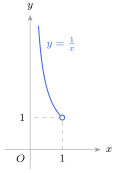
- ក. ដោយ \(\displaystyle f\) ជាអនុគមន៍សនិទាន មានភាគបែងខុសពី \(\displaystyle 0\) ក្នុងចន្លោះបើក \(\displaystyle (0, 1)\) ដូច្នេះ អនុគមន៍ \(\displaystyle f\) ជាប់លើចន្លោះ \(\displaystyle (0, 1)\) ។
- ខ. ដោយ \(\displaystyle f\) មិនកំណត់ត្រង់ \(\displaystyle x = 1\) នោះអនុគមន៍ \(\displaystyle f\) មិនជាប់ត្រង់ \(\displaystyle x = 1\) ។ ដូច្នេះ អនុគមន៍មិនជាប់ចំពោះគ្រប់តម្លៃ \(\displaystyle x\) ក្នុងចន្លោះ \(\displaystyle (0, 2)\) ។
- គ. ដោយអនុគមន៍ \(\displaystyle y = \sin x\) កំណត់ចំពោះគ្រប់ចំនួនពិតនោះ តាមលក្ខណៈនៃភាពជាប់គេថាអនុគមន៍ \(\displaystyle f\) ជាប់លើចន្លោះ \(\displaystyle (0, 2\pi)\) ។ ម្យ៉ាងទៀត \(\displaystyle \lim_{x \to 0^+} \sin x = \sin 0 = f(0) = 0\) និង \(\displaystyle \lim_{x \to (2\pi)^-} \sin x = \sin 2\pi = 0 = f(2\pi)\) ដូច្នេះ \(\displaystyle f\) ជាប់លើចន្លោះបិទ \(\displaystyle [0, 2\pi]\) ។
ប្រតិបត្តិ : គេមានអនុគមន៍ \(\displaystyle f\) កំណត់ដោយ \(\displaystyle f(x) = \sqrt{\dfrac{2 - x}{3 + x}}\) ។ តើ \(\displaystyle f\) ជាអនុគមន៍ជាប់លើចន្លោះ \(\displaystyle (-3, 2)\), \(\displaystyle (-3, 2]\) ឬទេ ?
ចម្លើយ : \(\displaystyle f\) ជាប់លើចន្លោះ \(\displaystyle (-3, 2)\) និង \(\displaystyle (-3, 2]\) ។
5. ភាពជាប់នៃអនុគមន៍បណ្តាក់
ឧទាហរណ៍ : គេមាន \(\displaystyle h(x) = \cos\left(x + \dfrac{\pi}{3}\right)\) ។ តាង \(\displaystyle f(x) = \cos x\) និង \(\displaystyle g(x) = x + \dfrac{\pi}{3}\) ។ \(\displaystyle g\) ជាអនុគមន៍ជាប់ត្រង់ \(\displaystyle x = 0\) ។ \(\displaystyle f\) ជាអនុគមន៍ជាប់ត្រង់ \(\displaystyle g(0) = \dfrac{\pi}{3}\) ។ ដូច្នេះ \(\displaystyle h = f \circ g\) ជាប់ត្រង់ \(\displaystyle x = 0\) ។
បើអនុគមន៍ \(\displaystyle g\) ជាប់ត្រង់ \(\displaystyle c\) និងអនុគមន៍ \(\displaystyle f\) ជាប់ត្រង់ \(\displaystyle g(c)\) នោះអនុគមន៍បណ្តាក់ \(\displaystyle (f \circ g)(x) = f[g(x)]\) ជាប់ត្រង់ \(\displaystyle c\) ។
លំហាត់គំរូ 1 : សិក្សាភាពជាប់នៃអនុគមន៍ \(\displaystyle h(x) = \left|\dfrac{x\sin x}{x^2 + 2}\right|\) ត្រង់ \(\displaystyle x = 0\) ។
ដំណោះស្រាយ : តាង \(\displaystyle f(x) = \dfrac{x\sin x}{x^2 + 2}\) ជាអនុគមន៍សនិទានជាប់ត្រង់ \(\displaystyle x = 0\) ហើយនិង \(\displaystyle g(x) = |x|\) ជាប់ត្រង់ \(\displaystyle x = 0\) នាំឱ្យអនុគមន៍ \(\displaystyle h = (f \circ g)(x)\) ជាប់ត្រង់ \(\displaystyle x = 0\) ។
លំហាត់គំរូ 2 : គេមាន \(\displaystyle f(x) = \sqrt{\dfrac{x + 4}{x - 4}}\) ។ តើអនុគមន៍ \(\displaystyle f\) ជាប់នៅលើចន្លោះណាខ្លះ ?
ដំណោះស្រាយ : តាង \(\displaystyle g(x) = \sqrt{x}\) មានន័យថាចំពោះ \(\displaystyle x \ge 0\) និង \(\displaystyle h(x) = \dfrac{x + 4}{x - 4}\) ជាប់លើចន្លោះ \(\displaystyle (-\infty, 4) \cup (4, +\infty)\) ។ បើ \(\displaystyle g(x) = \sqrt{x}\) ជាប់ចំពោះគ្រប់ \(\displaystyle x \ge 0\) នោះនាំឱ្យ \(\displaystyle f(x)\) ជាប់ចំពោះ \(\displaystyle x \in (-\infty, -4) \cup (4, +\infty)\) ។ ម្យ៉ាងទៀត \(\displaystyle \lim_{x \to -4^-} \sqrt{\dfrac{x + 4}{x - 4}} = 0 = f(-4)\) នាំឱ្យអនុគមន៍ \(\displaystyle f\) ជាប់នៅលើចន្លោះ \(\displaystyle x \in (-\infty, -4] \cup (4, +\infty)\) ។
ប្រតិបត្តិ : កំណត់តម្លៃ \(\displaystyle x\) ដែលធ្វើឱ្យអនុគមន៍ខាងក្រោមជាអនុគមន៍ជាប់ ។
- ក. \(\displaystyle f(x) = \sqrt{1 - x^2}\)
- ខ. \(\displaystyle g(x) = |x^2 - 1|\)
- គ. \(\displaystyle f(x) = \sqrt{\dfrac{2x}{x - 2}}\) ។
ចម្លើយ : ក. \(\displaystyle -1 \le x \le 1\) ខ. \(\displaystyle x \in \mathbb{R}\) គ. \(\displaystyle x \in (-\infty, 0] \cup (2, +\infty)\) ។
6. អនុវត្តន៍អនុគមន៍បន្លាយតាមភាពជាប់
ឧទាហរណ៍ 1 : គេមានអនុគមន៍ \(\displaystyle f\) កំណត់ដោយ \(\displaystyle f(x) = \dfrac{x^2 - 1}{x - 1}\) ។ តើ \(\displaystyle f\) ជាអនុគមន៍ជាប់ត្រង់ \(\displaystyle x = 1\) ឬទេ ?
គេសង្កេតឃើញថា \(\displaystyle \lim_{x \to 1} f(x) = \lim_{x \to 1} \dfrac{x^2 - 1}{x - 1} = \lim_{x \to 1} \dfrac{(x + 1)(x - 1)}{x - 1} = \lim_{x \to 1} (x + 1) = 2\) ប៉ុន្តែ \(\displaystyle f\) មិនកំណត់ត្រង់ \(\displaystyle x = 1\) ទេ នាំឱ្យអនុគមន៍ \(\displaystyle f\) មិនជាប់ត្រង់ \(\displaystyle x = 1\) ទេ ។ ដូច្នេះ បើគេយក \(\displaystyle g\) ជាអនុគមន៍កំណត់ដោយ \(\displaystyle g(x) = \begin{cases} \dfrac{x^2 - 1}{x - 1} & \text{បើ } x \neq 1 \\ 2 & \text{បើ } x = 1 \end{cases}\) គេថា \(\displaystyle g\) ជាបន្លាយនៃអនុគមន៍ \(\displaystyle f\) តាមភាពជាប់ត្រង់ \(\displaystyle 1\) ។
ឧទាហរណ៍ 2 : គេមានអនុគមន៍ \(\displaystyle f(x) = \dfrac{1 - \cos x}{x^2}\) ។ តើ \(\displaystyle f\) អាចមានអនុគមន៍បន្លាយតាមភាពជាប់ត្រង់ \(\displaystyle 0\) ឬទេ ?
អនុគមន៍ \(\displaystyle f\) មានន័យកាលណា \(\displaystyle x^2 \neq 0 \iff x \neq 0\) ។ ដែនកំណត់នៃ \(\displaystyle f\) គឺ \(\displaystyle D = \mathbb{R} - \{0\}\) ។ គេបាន \(\displaystyle \lim_{x \to 0} f(x) = \lim_{x \to 0} \dfrac{1 - \cos x}{x^2} = \lim_{x \to 0} \dfrac{2\sin^2\frac{x}{2}}{x^2} = \dfrac{2}{4} \lim_{x \to 0} \left(\dfrac{\sin\frac{x}{2}}{\frac{x}{2}}\right)\left(\dfrac{\sin\frac{x}{2}}{\frac{x}{2}}\right) = \dfrac{2}{4} \times 1 \times 1 = \dfrac{1}{2}\) បើគេយក \(\displaystyle g\) ជាអនុគមន៍កំណត់ដោយ \(\displaystyle g(x) = \begin{cases} \dfrac{1 - \cos x}{x^2} & \text{បើ } x \neq 0 \\ \dfrac{1}{2} & \text{បើ } x = 0 \end{cases}\) នោះ \(\displaystyle g\) ជាអនុគមន៍ជាប់ត្រង់ \(\displaystyle x = 0\) ។ គេថា \(\displaystyle g\) ជាបន្លាយនៃអនុគមន៍ \(\displaystyle f\) តាមភាពជាប់ត្រង់ \(\displaystyle 0\) ។
បើ \(\displaystyle f\) ជាអនុគមន៍មិនកំណត់ត្រង់ \(\displaystyle x = a\) និងមានលីមីត \(\displaystyle \lim_{x \to a} f(x) = \ell\) នោះអនុគមន៍បន្លាយនៃ \(\displaystyle f\) តាមភាពជាប់ត្រង់ \(\displaystyle x = a\) កំណត់ដោយ \(\displaystyle g(x) = \begin{cases} f(x) & \text{បើ } x \neq a \\ \ell & \text{បើ } x = a \end{cases}\) ។
ប្រតិបត្តិ :
- ក. កំណត់អនុគមន៍បន្លាយភាពជាប់នៃ \(\displaystyle f\) តាមភាពជាប់ត្រង់ \(\displaystyle x = 2\) ដែល \(\displaystyle f(x) = \dfrac{x^2 - 4x + 4}{x - 2}\) ។
- ខ. កំណត់អនុគមន៍បន្លាយភាពជាប់នៃ \(\displaystyle f\) តាមភាពជាប់ត្រង់ \(\displaystyle x = 0\) ដែល \(\displaystyle f(x) = \dfrac{e^{3x} - 1}{x}\) ។
ចម្លើយ : ក. \(\displaystyle g(x) = \begin{cases} f(x) & \text{បើ } x \neq 2 \\ 0 & \text{បើ } x = 2 \end{cases}\) ខ. \(\displaystyle g(x) = \begin{cases} f(x) & \text{បើ } x \neq 0 \\ 3 & \text{បើ } x = 0 \end{cases}\) ។
7. ទ្រឹស្តីបទតម្លៃកណ្តាល
ឧទាហរណ៍ 1 : បូជាមានកម្ពស់ \(\displaystyle 1.30\text{ m}\) នៅពេលខួបកំណើតគម្រប់អាយុ \(\displaystyle 13\) ឆ្នាំ និងមានកម្ពស់ \(\displaystyle 1.50\text{ m}\) នៅពេលខួបកំណើតគម្រប់អាយុ \(\displaystyle 14\) ឆ្នាំ ។ ដូច្នេះត្រូវមានរយៈពេល \(\displaystyle t\) មួយ \(\displaystyle 13 < t < 14\) ដែលកម្ពស់ស្មើ \(\displaystyle h\) ហើយ \(\displaystyle 1.30\text{ m} < h < 1.50\text{ m}\) ។
ឧទាហរណ៍ 2 : គេមាន \(\displaystyle f(x) = x^2 - 2\) ។ លើចន្លោះ \(\displaystyle [0, 2]\), \(\displaystyle f\) ជាប់និងកើន ។ គេបាន \(\displaystyle f(0) = -2\) និង \(\displaystyle f(2) = 2\) ។ យក \(\displaystyle k\), \(\displaystyle f(0) \le k \le f(2)\) សមីការ \(\displaystyle x^2 - 2 = k\) សរសេរជា \(\displaystyle x^2 = k + 2\) ។ ដោយ \(\displaystyle -2 \le k \le 2\) នោះ \(\displaystyle k + 2 \ge 0\) ។ ដូច្នេះ លើចន្លោះ \(\displaystyle [0, 2]\) គេបាន \(\displaystyle x = \sqrt{k + 2}\) ។ គ្រប់ \(\displaystyle k\) ដែល \(\displaystyle f(0) \le k \le f(2)\) សមីការ \(\displaystyle x^2 - 2 = k\) មានឫស \(\displaystyle x = c\) មួយដែល \(\displaystyle 0 \le c \le 2\) ។
ទ្រឹស្តីបទ : បើអនុគមន៍ \(\displaystyle f\) ជាប់លើចន្លោះបិទ \(\displaystyle [a, b]\) និង \(\displaystyle k\) ជាចំនួនមួយនៅចន្លោះ \(\displaystyle f(a)\) និង \(\displaystyle f(b)\) នោះមានចំនួនពិត \(\displaystyle c\) មួយយ៉ាងតិចក្នុងចន្លោះ \(\displaystyle (a, b)\) ដែល \(\displaystyle f(c) = k\) ។
វិបាក : បើអនុគមន៍ \(\displaystyle f\) ជាប់ ហើយកើនដាច់ខាត ឬក៏ចុះដាច់ខាតលើចន្លោះបិទ \(\displaystyle [a, b]\) នោះចំពោះគ្រប់ចំនួន \(\displaystyle k\) នៅចន្លោះ \(\displaystyle f(a)\) និង \(\displaystyle f(b)\) សមីការ \(\displaystyle f(x) = k\) មានចម្លើយតែមួយគត់ក្នុងចន្លោះ \(\displaystyle (a, b)\) ។
សម្រាយបញ្ជាក់ : អនុគមន៍ \(\displaystyle f\) ជាប់និងកើនដាច់ខាតលើចន្លោះបិទ \(\displaystyle [a, b]\) ។ \(\displaystyle f\) កើនដាច់ខាតមានន័យថា បើ \(\displaystyle x\) និង \(\displaystyle x'\) ជាពីរចំនួននៅក្នុងចន្លោះ \(\displaystyle [a, b]\) ដែល \(\displaystyle x < x'\) នោះ \(\displaystyle f(x) < f(x')\) ។ ឱ្យចំនួន \(\displaystyle k\) នៅចន្លោះ \(\displaystyle f(a)\) និង \(\displaystyle f(b)\), \(\displaystyle f(a) < k < f(b)\) និង \(\displaystyle f\) ជាអនុគមន៍ជាប់តាមទ្រឹស្តីបទបញ្ជាក់ថាមានចំនួន \(\displaystyle c\) មួយនៅចន្លោះ \(\displaystyle a\) និង \(\displaystyle b\) ដែល \(\displaystyle f(c) = k\) ។
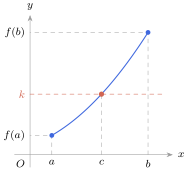
ឧបមាថាមានចំនួនមួយទៀត \(\displaystyle c'\) ខុសពី \(\displaystyle c\) ផ្ទៀងផ្ទាត់គ្នា \(\displaystyle f(c') = k\) នោះ \(\displaystyle f(c) = f(c')\) ជាករណីផ្ទុយពីសម្មតិកម្មដែលថា \(\displaystyle f\) កើនដាច់ខាត ។ ដូច្នេះមានចំនួន \(\displaystyle c\) មួយគត់ដែលផ្ទៀងផ្ទាត់ \(\displaystyle f(c) = k\) គឺសមីការ \(\displaystyle f(x) = k\) មានចម្លើយតែមួយគត់ ។
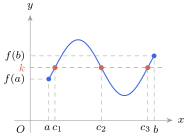
គេឃើញថាចំពោះតម្លៃ \(\displaystyle k\) អាចមានតម្លៃ \(\displaystyle c\) ច្រើនជាងមួយ ។ ទ្រឹស្តីបទបញ្ជាក់ថាយ៉ាងហោចណាស់មានចំនួន \(\displaystyle c\) មួយ ប៉ុន្តែមិនមែនតែមួយគត់ទេ ។ បង្ហាញថាមានតម្លៃ \(\displaystyle c\) បី \(\displaystyle c_1, c_2, c_3\) ។
លំហាត់គំរូ 1 : គេមានអនុគមន៍ \(\displaystyle f\) កំណត់ដោយ \(\displaystyle f(x) = \begin{cases} x - 1 & \text{បើ } 0 \le x \le 2 \\ x^2 & \text{បើ } 2 < x \le 3 \end{cases}\) ។ តើគ្រប់ \(\displaystyle -1 \le k \le 9\) មាន \(\displaystyle c\) ដែល \(\displaystyle f(c) = k\) ឬទេ ?
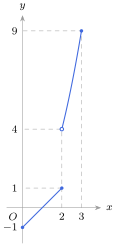
ដំណោះស្រាយ : តាមក្រាបនៃអនុគមន៍បង្ហាញថា \(\displaystyle f\) ជាអនុគមន៍ដាច់ត្រង់ \(\displaystyle 2\) ដែលស្ថិតក្នុងចន្លោះ \(\displaystyle [0, 3]\) ។ គេបាន \(\displaystyle f(0) = -1\) និង \(\displaystyle f(3) = 9\) បើ \(\displaystyle k\) ជាចំនួនណាមួយនៅចន្លោះ \(\displaystyle 1\) និង \(\displaystyle 4\) នោះគ្មានតម្លៃ \(\displaystyle c\) ដែល \(\displaystyle f(c) = k\) ព្រោះគ្មានតម្លៃអនុគមន៍ចន្លោះ \(\displaystyle 1\) និង \(\displaystyle 4\) ។
សម្គាល់ : ទ្រឹស្តីបទតម្លៃកណ្តាលអាចប្រើបានចំពោះ \(\displaystyle k = 0\) ជាពិសេសបើអនុគមន៍ \(\displaystyle f\) ជាប់លើចន្លោះបិទ \(\displaystyle [a, b]\), \(\displaystyle f(a)\) និង \(\displaystyle f(b)\) មានសញ្ញាផ្ទុយគ្នានោះ (\(\displaystyle f(a) \cdot f(b) < 0\)) មានចំនួន \(\displaystyle c\) មួយយ៉ាងតិចក្នុងចន្លោះបិទ \(\displaystyle [a, b]\) ដែល \(\displaystyle f(c) = 0\) ។
លំហាត់គំរូ 2 : ដោយប្រើទ្រឹស្តីបទតម្លៃកណ្តាល ចូរបង្ហាញថាចំពោះអនុគមន៍ពហុធា \(\displaystyle f(x) = x^3 + 2x - 1\) មានចំនួនពិត \(\displaystyle c\) នៅក្នុងចន្លោះ \(\displaystyle [0, 1]\) ដែល \(\displaystyle f(c) = 0\) ។
ដំណោះស្រាយ : ដោយ \(\displaystyle f(0) = 0^3 + 2(0) - 1 = -1\) និង \(\displaystyle f(1) = 1^3 + 2(1) - 1 = 2\) គេបាន \(\displaystyle f(0) \cdot f(1) = (-1)(2) = -2 < 0\) ។ តាមទ្រឹស្តីបទតម្លៃកណ្តាលដោយ \(\displaystyle f(0) \cdot f(1) < 0\) មានចំនួន \(\displaystyle c\) មួយយ៉ាងតិចក្នុងចន្លោះបិទ \(\displaystyle [0, 1]\) ដែល \(\displaystyle f(c) = 0\) ។
លំហាត់គំរូ 3 : គេឱ្យអនុគមន៍ \(\displaystyle f\) កំណត់ដោយ \(\displaystyle f(x) = 4 + 3x - x^2\) ដែល \(\displaystyle 2 \le x \le 5\) ។ ប្រើទ្រឹស្តីបទតម្លៃកណ្តាលរកតម្លៃ \(\displaystyle c\) បើ \(\displaystyle k = 1\) ។
ដំណោះស្រាយ : គេបាន \(\displaystyle f(2) = 6\), \(\displaystyle f(5) = -6\) ។ ដើម្បីរក \(\displaystyle c\) គេមាន \(\displaystyle f(c) = k = 1\) ។ \(\displaystyle 4 + 3c - c^2 = 1\), \(\displaystyle c^2 - 3c - 3 = 0\) គេបាន \(\displaystyle c = \dfrac{3 \pm \sqrt{21}}{2}\), \(\displaystyle c \in [2, 5]\) នោះ \(\displaystyle c = \dfrac{3 + \sqrt{21}}{2}\) ។
ប្រតិបត្តិ : ប្រើទ្រឹស្តីបទតម្លៃកណ្តាលបង្ហាញថាសមីការ \(\displaystyle x^5 - 3x - 1 = 0\) មានឫសយ៉ាងតិចមួយក្នុងចន្លោះ \(\displaystyle (1, 2)\) ។
ចម្លើយ : តាង \(\displaystyle f(x) = x^5 - 3x - 1\) ជាប់លើ \(\displaystyle [1, 2]\) ។ \(\displaystyle f(1) = -3 < 0\) និង \(\displaystyle f(2) = 25 > 0 \implies f(1)\cdot f(2) < 0\) ដូច្នេះសមីការមានឫសយ៉ាងតិចមួយក្នុង \(\displaystyle (1, 2)\) ។
លំហាត់
បញ្ជាក់ថា តើអនុគមន៍ខាងក្រោមជាប់ត្រង់តម្លៃ \(\displaystyle x\) ដែលឱ្យឬទេ ?
- ក. \(\displaystyle f(x) = 5x^2 - 6x + 1,\ x = 2\)
- ខ. \(\displaystyle f(x) = \dfrac{x + 2}{x - 1},\ x = 1\)
- គ. \(\displaystyle f(x) = \dfrac{\sqrt{x} - 2}{x - 4},\ x = 4\)
- ឃ. \(\displaystyle f(x) = \dfrac{|x + 2|}{x + 2},\ x = -2\)
- ង. \(\displaystyle f(x) = \begin{cases} x + 1 & \text{បើ } x \le 2 \\ 2 & \text{បើ } x > 2 \end{cases},\ x = 2\)
- ច. \(\displaystyle f(x) = \begin{cases} \dfrac{x^2 - 1}{x + 1} & \text{បើ } x < -1 \\ x^2 - 3 & \text{បើ } x \ge -1 \end{cases},\ x = -1\) ។
រកតម្លៃ \(\displaystyle x\) ដែលធ្វើឱ្យអនុគមន៍ខាងក្រោមជាអនុគមន៍ដាច់ ។
- ក. \(\displaystyle f(x) = \dfrac{3x - 1}{2x - 6}\)
- ខ. \(\displaystyle f(x) = \dfrac{x}{x^2 + 4x - 5}\)
- គ. \(\displaystyle f(x) = \dfrac{x^2 - 2x + 1}{x^2 - x - 2}\)
- ឃ. \(\displaystyle f(x) = \dfrac{3x - 2}{x^2 - 3x - 18}\)
- ង. \(\displaystyle f(x) = \begin{cases} \dfrac{x}{2} + 1 & \text{បើ } x \le 2 \\ 3 - x & \text{បើ } x > 2 \end{cases}\)
- ច. \(\displaystyle f(x) = \begin{cases} -x + 1 & \text{បើ } x \le -1 \\ 2 & \text{បើ } -1 < x < 1 \\ -x + 3 & \text{បើ } x > 1 \end{cases}\) ។
សិក្សាភាពជាប់នៃអនុគមន៍ខាងក្រោមលើចន្លោះដែលឱ្យ ។
- ក. \(\displaystyle f(x) = \dfrac{x - 4}{4 + x}\) លើចន្លោះ \(\displaystyle (0, 1)\) និង \(\displaystyle [-4, 1]\)
- ខ. \(\displaystyle f(x) = x\left(1 + \dfrac{1}{x}\right)\) លើចន្លោះ \(\displaystyle (0, 1)\) និង \(\displaystyle [0, 1]\)
- គ. \(\displaystyle f(x) = \begin{cases} x(x - 1) & \text{បើ } x < 3 \\ \dfrac{x^2 - 9}{x - 3} & \text{បើ } x \ge 3 \end{cases}\) លើចន្លោះ \(\displaystyle (0, 3)\) និង \(\displaystyle [0, 3]\) ។
រកតម្លៃ \(\displaystyle A\) ដែលធ្វើឱ្យអនុគមន៍ \(\displaystyle f(x)\) ជាប់គ្រប់តម្លៃ \(\displaystyle x\)
- ក. \(\displaystyle f(x) = \begin{cases} Ax - 3 & \text{បើ } x \le 3 \\ 3 - x + 2x^2 & \text{បើ } x > 3 \end{cases}\)
- ខ. \(\displaystyle f(x) = \begin{cases} 1 - 3x & \text{បើ } x < 4 \\ Ax^2 + 2x - 3 & \text{បើ } x \ge 4 \end{cases}\) ។
រកតម្លៃ \(\displaystyle A\) និង \(\displaystyle B\) ដែលធ្វើឱ្យអនុគមន៍កំណត់ដោយ
\[f(x) = \begin{cases} Ax^2 + 5x - 9 & \text{បើ } x < 1 \\ B & \text{បើ } x = 1 \\ (3 - x)(A - 2x) & \text{បើ } x > 1 \end{cases}\]ជាប់គ្រប់តម្លៃ \(\displaystyle x\) ។
ក្នុងបណ្តាអនុគមន៍ខាងក្រោម តើ \(\displaystyle f\) អាចមានបន្លាយតាមភាពជាប់ត្រង់ \(\displaystyle a\) ឬទេ ?
- ក. \(\displaystyle f(x) = \dfrac{x^2 - 9}{x - 3},\ a = 3\)
- ខ. \(\displaystyle f(x) = \dfrac{x^2 + 3x - 10}{x - 2},\ a = 2\)
- គ. \(\displaystyle f(x) = \dfrac{x^3 - 1}{x - 1},\ a = 1\)
- ឃ. \(\displaystyle f(x) = \dfrac{x^2 - 16}{x^2 - 3x + 4},\ a = 4\) ។
ប្រើទ្រឹស្តីបទតម្លៃកណ្តាលបង្ហាញថា អនុគមន៍ខាងក្រោមមានចំនួន \(\displaystyle c\) ក្នុងចន្លោះដែលឱ្យ ៖
- ក. \(\displaystyle f(x) = x^2 + x - 1,\ [0, 5],\ f(c) = 11\)
- ខ. \(\displaystyle f(x) = x^2 - 6x + 8,\ [0, 3],\ f(c) = 0\)
- គ. \(\displaystyle f(x) = x^3 - x^2 + x - 2,\ [0, 3],\ f(c) = 4\)
- ឃ. \(\displaystyle f(x) = \dfrac{x^2 + x}{x - 1},\ \left[\dfrac{5}{2}, 4\right],\ f(c) = 6\) ។
គេឱ្យអនុគមន៍និងចន្លោះបិទដូចខាងក្រោម ។ ប្រើទ្រឹស្តីបទតម្លៃកណ្តាល រកតម្លៃ \(\displaystyle c\) បើគេស្គាល់តម្លៃ \(\displaystyle k\) ។
- ក. \(\displaystyle f(x) = 2 + x - x^2,\ [0, 3],\ k = 1\)
- ខ. \(\displaystyle f(x) = \sqrt{25 - x^2},\ [-4.5, 3],\ k = 3\) ។
- ក. ស្រាយបញ្ជាក់ថាសមីការ \(\displaystyle x\tan x = \cos x\) យ៉ាងហោចណាស់មានឫសពិតមួយចន្លោះ \(\displaystyle \left[0, \dfrac{\pi}{4}\right]\) ។
- ខ. ស្រាយបញ្ជាក់ថា សមីការ \(\displaystyle (x^n - 1)\cos x + \sqrt{2}\sin x - 1 = 0\) យ៉ាងហោចណាស់មានឫសពិតមួយចន្លោះ \(\displaystyle (0, 1)\) ។
ចម្លើយលំហាត់
- 1. ក. ជាប់ ខ. ដាច់ គ. ដាច់ ឃ. ដាច់ ង. ដាច់ ច. ជាប់ ។
- 2. ក. \(\displaystyle x = 3\) ខ. \(\displaystyle x = 1,\ x = -5\) គ. \(\displaystyle x = 2,\ x = -1\) ឃ. \(\displaystyle x = 6,\ x = -3\) ង. ដាច់ត្រង់ \(\displaystyle x = 2\) ច. ដាច់ត្រង់ \(\displaystyle x = 1\) (និងមិនកំណត់ត្រង់ \(\displaystyle x = 1\)) ។
- 3. ក. ជាប់លើ \(\displaystyle (0, 1)\), មិនជាប់លើ \(\displaystyle [-4, 1]\) ខ. ជាប់លើ \(\displaystyle (0, 1)\), មិនជាប់លើ \(\displaystyle [0, 1]\) គ. ជាប់លើ \(\displaystyle (0, 3)\) និង \(\displaystyle [0, 3]\) ។
- 4. ក. \(\displaystyle A = 7\) ខ. \(\displaystyle A = -1\) ។
- 5. \(\displaystyle A = 0,\ B = -4\) ។
- 6. ក. បាន (\(\displaystyle g(3) = 6\)) ខ. បាន (\(\displaystyle g(2) = 7\)) គ. បាន (\(\displaystyle g(1) = 3\)) ឃ. អនុគមន៍កំណត់និងជាប់ស្រាប់ត្រង់ \(\displaystyle a = 4\) (\(\displaystyle f(4) = 0\)) ។
- 7. ក. \(\displaystyle c = 3\) ខ. \(\displaystyle c = 2\) គ. \(\displaystyle c = 2\) ឃ. \(\displaystyle c = 3\) ។
- 8. ក. \(\displaystyle c = \dfrac{1 + \sqrt{5}}{2}\) ខ. \(\displaystyle c = -4\) ។
- 9. ក. តាង \(\displaystyle g(x) = x\tan x - \cos x\): \(\displaystyle g(0) = -1 < 0\), \(\displaystyle g\left(\frac{\pi}{4}\right) = \frac{\pi}{4} - \frac{\sqrt{2}}{2} > 0\) ខ. តាង \(\displaystyle h(x) = (x^n - 1)\cos x + \sqrt{2}\sin x - 1\): \(\displaystyle h(0) = -2 < 0\), \(\displaystyle h(1) = \sqrt{2}\sin 1 - 1 > 0\) ។
មេរៀនសង្ខេប
លីមីតនៃអនុគមន៍ត្រង់ចំនួនកំណត់
- អនុគមន៍ \(\displaystyle f\) មានលីមីត \(\displaystyle L\) កាលណា \(\displaystyle x\) ខិតជិត \(\displaystyle a\) បើគ្រប់ចំនួន \(\displaystyle \varepsilon > 0\) មានចំនួន \(\displaystyle \delta > 0\) ដែល \(\displaystyle 0 < |x - a| < \delta\) នាំឱ្យ \(\displaystyle |f(x) - L| < \varepsilon\) ។ គេសរសេរ \(\displaystyle \lim_{x \to a} f(x) = L\) ។
- គេថាអនុគមន៍ \(\displaystyle f\) ខិតជិត \(\displaystyle +\infty\) ឬ \(\displaystyle -\infty\) កាលណា \(\displaystyle x\) ខិតជិត \(\displaystyle a\) បើចំពោះគ្រប់ចំនួន \(\displaystyle M > 0\) គេមាន \(\displaystyle \delta > 0\) ដែល \(\displaystyle 0 < |x - a| < \delta\) នាំឱ្យ \(\displaystyle f(x) > M\) ឬ \(\displaystyle f(x) < -M\) ។ គេសរសេរ \(\displaystyle \lim_{x \to a} f(x) = +\infty\) ឬ \(\displaystyle \lim_{x \to a} f(x) = -\infty\) ។
លីមីតនៃអនុគមន៍ត្រង់អនន្ត
- អនុគមន៍ \(\displaystyle f\) មានលីមីត \(\displaystyle L\) កាលណា \(\displaystyle x\) ខិតជិត \(\displaystyle +\infty\) ឬ \(\displaystyle -\infty\) បើចំពោះគ្រប់ចំនួន \(\displaystyle \varepsilon > 0\) គេអាចរក \(\displaystyle N > 0\) ដែល \(\displaystyle x > N\) ឬ \(\displaystyle x < -N\) នាំឱ្យ \(\displaystyle |f(x) - L| < \varepsilon\) ។ គេសរសេរ \(\displaystyle \lim_{x \to +\infty} f(x) = L\) ឬ \(\displaystyle \lim_{x \to -\infty} f(x) = L\) ។
- អនុគមន៍ \(\displaystyle f\) មានលីមីត \(\displaystyle +\infty\) កាលណា \(\displaystyle x\) ខិតជិត \(\displaystyle +\infty\) បើចំពោះគ្រប់ចំនួន \(\displaystyle M > 0\) គេមាន \(\displaystyle N > 0\) ដែល \(\displaystyle x > N\) នាំឱ្យ \(\displaystyle f(x) > M\) គេសរសេរ \(\displaystyle \lim_{x \to +\infty} f(x) = +\infty\) ។
- អនុគមន៍ \(\displaystyle f\) មានលីមីត \(\displaystyle +\infty\) កាលណា \(\displaystyle x\) ខិតជិត \(\displaystyle -\infty\) បើចំពោះគ្រប់ចំនួន \(\displaystyle M > 0\) គេមាន \(\displaystyle N > 0\) ដែល \(\displaystyle x < -N\) នាំឱ្យ \(\displaystyle f(x) > M\) គេសរសេរ \(\displaystyle \lim_{x \to -\infty} f(x) = +\infty\) ។
ប្រមាណវិធីលើលីមីត : បើ \(\displaystyle \lim_{x \to a} f(x) = L\), \(\displaystyle \lim_{x \to a} g(x) = M\), \(\displaystyle \lim_{x \to a} h(x) = N\) ហើយ \(\displaystyle L, M, N\) ជាចំនួនពិត គេបាន
- \(\displaystyle \lim_{x \to a} [f(x) \pm g(x)] = L \pm M\) (ដែល \(\displaystyle a\) អាចជាចំនួនកំណត់ឬអនន្ត)
- \(\displaystyle \lim_{x \to a} [f(x) + g(x) - h(x)] = L + M - N\)
- \(\displaystyle \lim_{x \to a} kf(x) = kL\), \(\displaystyle k\) ជាចំនួនថេរ
- \(\displaystyle \lim_{x \to a} [f(x) \cdot g(x) \cdot h(x)] = L \cdot M \cdot N\)
- \(\displaystyle \lim_{x \to a} \dfrac{f(x)}{g(x)} = \dfrac{\lim_{x \to a} f(x)}{\lim_{x \to a} g(x)} = \dfrac{L}{M}\) ដែល \(\displaystyle M \neq 0\), \(\displaystyle g(a) \neq 0\)
- \(\displaystyle \lim_{x \to a} [f(x)]^n = L^n\) ដែល \(\displaystyle n\) ជាចំនួនគត់រ៉ឺឡាទីបវិជ្ជមាន ។
- លីមីតនៃអនុគមន៍អសនិទាន : \(\displaystyle \lim_{x \to a} \sqrt[n]{x} = \sqrt[n]{a}\) ចំពោះ \(\displaystyle a \ge 0\) និង \(\displaystyle n \in \mathbb{N}\) ឬ \(\displaystyle a < 0\) និង \(\displaystyle n\) ជាចំនួនគត់សេស ; \(\displaystyle \lim_{x \to a} \sqrt[n]{f(x)} = \sqrt[n]{\lim_{x \to a} f(x)} = \sqrt[n]{L} = L^{\frac{1}{n}}\) បើ \(\displaystyle L > 0\) និង \(\displaystyle n\) ជាចំនួនគត់គូ ឬបើ \(\displaystyle L \le 0\) និង \(\displaystyle n\) ជាចំនួនគត់សេស ។
- លីមីតនៃអនុគមន៍បណ្តាក់ : និយមន័យ \(\displaystyle (g \circ f)(x) = g[f(x)]\); លីមីត \(\displaystyle \lim_{x \to a} f[g(x)] = f(L)\) (បើ \(\displaystyle \lim_{x \to a} g(x) = L\) និង \(\displaystyle \lim_{x \to L} f(x) = f(L)\)) ។
- លីមីតតាមការប្រៀបធៀប : បើ \(\displaystyle f(x) \ge g(x)\) ចំពោះ \(\displaystyle x \ge A\) និង \(\displaystyle \lim_{x \to +\infty} g(x) = +\infty\) នោះ \(\displaystyle \lim_{x \to +\infty} f(x) = +\infty\); បើ \(\displaystyle f(x) \le g(x)\) ចំពោះ \(\displaystyle x \ge A\) និង \(\displaystyle \lim_{x \to +\infty} g(x) = -\infty\) នោះ \(\displaystyle \lim_{x \to +\infty} f(x) = -\infty\); បើ \(\displaystyle g(x) \le f(x) \le h(x)\) ចំពោះ \(\displaystyle x \ge A\) និង \(\displaystyle \lim_{x \to +\infty} g(x) = \lim_{x \to +\infty} h(x) = \lambda\) នោះ \(\displaystyle \lim_{x \to +\infty} f(x) = \lambda\); បើ \(\displaystyle f(x) \le g(x)\) ចំពោះ \(\displaystyle x \ge A\) នោះ \(\displaystyle \lambda \le \lambda'\) ។
- លីមីតមានរាងមិនកំណត់ : \(\displaystyle \dfrac{0}{0}\) (បំបែកភាគយកនិងភាគបែងជាផលគុណកត្តា រួចសម្រួល), \(\displaystyle \dfrac{\infty}{\infty}\) (ដាក់តួដឺក្រេធំជាងគេជាកត្តារួចសម្រួល), \(\displaystyle +\infty - \infty\) (ដាក់តួដឺក្រេខ្ពស់ជាងគេជាកត្តា ឬគុណកន្សោមឆ្លាស់) ។
- លីមីតនៃអនុគមន៍ត្រីកោណមាត្រ : \(\displaystyle \lim_{x \to a} \sin x = \sin a\), \(\displaystyle \lim_{x \to a} \cos x = \cos a\), \(\displaystyle \lim_{x \to a} \tan x = \tan a\); \(\displaystyle \lim_{x \to 0} \dfrac{\sin x}{x} = 1\) និង \(\displaystyle \lim_{x \to 0} \dfrac{1 - \cos x}{x} = 0\) ។
- លីមីតនៃអនុគមន៍អិចស្ប៉ូណង់ស្យែល : \(\displaystyle \lim_{x \to +\infty} e^x = +\infty\), \(\displaystyle \lim_{x \to -\infty} e^x = 0\), \(\displaystyle \lim_{x \to +\infty} \dfrac{e^x}{x^n} = +\infty\), \(\displaystyle \lim_{x \to +\infty} \dfrac{x^n}{e^x} = 0\) (\(\displaystyle n > 0\)), \(\displaystyle \lim_{x \to 0} \dfrac{e^x - 1}{x} = 1\) ។
- លីមីតនៃអនុគមន៍លោការីតនេពែ : \(\displaystyle \lim_{x \to +\infty} \ln x = +\infty\), \(\displaystyle \lim_{x \to 0^+} \ln x = -\infty\), \(\displaystyle \lim_{x \to +\infty} \dfrac{\ln x}{x^n} = 0\), \(\displaystyle \lim_{x \to 0^+} x^n \ln x = 0\) (\(\displaystyle n > 0\)), \(\displaystyle \lim_{x \to 0} \dfrac{\ln(1 + x)}{x} = 1\) ។
- ភាពជាប់ត្រង់មួយចំណុច : \(\displaystyle f\) កំណត់ត្រង់ \(\displaystyle c\), មានលីមីតកាលណា \(\displaystyle x \to c\), និង \(\displaystyle \lim_{x \to c} f(x) = f(c)\) ។
- លក្ខណៈភាពជាប់នៃអនុគមន៍ : បើ \(\displaystyle f, g\) ជាប់ត្រង់ \(\displaystyle c\) នោះ \(\displaystyle f \pm g\), \(\displaystyle f \cdot g\), \(\displaystyle kf\), \(\displaystyle \dfrac{f}{g}\) (\(\displaystyle g(c) \neq 0\)) ជាប់ត្រង់ \(\displaystyle c\) ។
- អនុគមន៍លីនេអ៊ែរ ពហុធា សនិទាន រ៉ាឌីកាល់ ត្រីកោណមាត្រ : ជាប់លើដែនកំណត់រៀងៗខ្លួន ។
- ភាពជាប់លើចន្លោះ : ជាប់លើ \(\displaystyle (a, b)\) និងលើ \(\displaystyle [a, b]\) ។
- ភាពជាប់នៃអនុគមន៍បណ្តាក់ : បើ \(\displaystyle g\) ជាប់ត្រង់ \(\displaystyle c\) និង \(\displaystyle f\) ជាប់ត្រង់ \(\displaystyle g(c)\) នោះ \(\displaystyle f \circ g\) ជាប់ត្រង់ \(\displaystyle c\) ។
- អនុគមន៍បន្លាយតាមភាពជាប់ : \(\displaystyle g(x) = f(x)\) បើ \(\displaystyle x \neq a\), \(\displaystyle g(a) = \ell\) ។
- ទ្រឹស្តីបទតម្លៃកណ្តាល : បើ \(\displaystyle f\) ជាប់លើ \(\displaystyle [a, b]\) និង \(\displaystyle k\) នៅចន្លោះ \(\displaystyle f(a)\) និង \(\displaystyle f(b)\) នោះមាន \(\displaystyle c \in (a, b)\) ដែល \(\displaystyle f(c) = k\) ។ បើ \(\displaystyle f\) ឯកតាណដាច់ខាត នោះ \(\displaystyle c\) មានតែមួយគត់ ។
លំហាត់ជំពូក 1
គណនាលីមីតខាងក្រោម ៖
- ក. \(\displaystyle \lim_{x \to +\infty} \left(\sqrt{4x^2 + x + 2} - \sqrt{x^2 - x + 3}\right)\)
- ខ. \(\displaystyle \lim_{x \to +\infty} \left(\sqrt{x^2 + x + 2} - \sqrt{x^2 - x + 3}\right)\)
- គ. \(\displaystyle \lim_{x \to 0} \dfrac{x^2 - x\sin x}{x - \sin^2 x}\)
- ឃ. \(\displaystyle \lim_{x \to 0} \dfrac{2x - \sin x}{\sqrt{1 - \cos x}}\)
- ង. \(\displaystyle \lim_{x \to 0} \dfrac{x\sin 3x}{\sin^2 5x}\)
- ច. \(\displaystyle \lim_{x \to 0} \dfrac{(1 - \cos x)^2}{\tan^3 x - \sin^3 x}\)
- ឆ. \(\displaystyle \lim_{x \to 0} \dfrac{\sqrt{2} - \sqrt{1 + \cos x}}{\sin^2 x}\)
- ជ. \(\displaystyle \lim_{x \to \frac{\pi}{2}} \dfrac{1 - \sin x}{\left(\frac{\pi}{2} - x\right)^2}\)
- ឈ. \(\displaystyle \lim_{x \to \pm\infty} x\sin\dfrac{1}{x}\)
- ញ. \(\displaystyle \lim_{x \to +\infty} x^2\left(1 - \cos\dfrac{1}{x}\right)\)
- ដ. \(\displaystyle \lim_{x \to 0} \dfrac{\tan x - \sin x}{x^3}\)
- ឋ. \(\displaystyle \lim_{x \to 0} \dfrac{1 + \sin x - \cos x}{1 - \sin x - \cos x}\)
- ឌ. \(\displaystyle \lim_{x \to 0} \dfrac{1 - \cos x\sqrt{\cos 2x}}{x^2}\)
- ឍ. \(\displaystyle \lim_{x \to 0} \dfrac{1 - \cos x \cdot \cos 2x}{x^2}\)
- ណ. \(\displaystyle \lim_{x \to \frac{\pi}{6}} \dfrac{2\sin^2 x - 3\sin x + 1}{4\sin^2 x - 1}\)
- ត. \(\displaystyle \lim_{x \to 0} \dfrac{1 + x\sin x - \cos 2x}{\sin^2 x}\)
- ថ. \(\displaystyle \lim_{x \to 0} \dfrac{x(a - b)}{\sin ax - \sin bx}\quad (a \neq 0, b \neq 0, a \neq b)\)
- ទ. \(\displaystyle \lim_{x \to 0} \dfrac{\sin^2 x}{\sqrt{1 + x\sin x} - \cos x}\)
- ធ. \(\displaystyle \lim_{x \to +\infty} \left(\sqrt{x^2 + 3x} - \sqrt{x^2 + 1} - 1\right)\)
- ន. \(\displaystyle \lim_{x \to 0} \dfrac{\sin 3x}{\sqrt{x + 2} - \sqrt{2}}\) ។
- កំណត់តម្លៃ \(\displaystyle a\) ដែលបំពេញលក្ខខណ្ឌ \(\displaystyle \lim_{x \to 0} \dfrac{1 + ax - \sqrt{1 + x}}{x} = \dfrac{1}{8}\) ។
គណនាលីមីត
- ក. \(\displaystyle \lim_{x \to 1} \dfrac{\sqrt[n]{x} - 1}{\sqrt[m]{x} - 1}\)
- ខ. \(\displaystyle \lim_{x \to a} \dfrac{\sqrt{x - b} - \sqrt{a - b}}{x^2 - a^2}\quad (a > 0 \text{ និង } b < 0)\) ។
គេមានអនុគមន៍ \(\displaystyle y = f(x)\) កំណត់លើចន្លោះ \(\displaystyle \left[-\dfrac{\pi}{2}, \dfrac{\pi}{2}\right]\) ដែល
\[f(x) = \begin{cases} \sin x + \dfrac{\sqrt{1 - \cos 2x}}{\sin x} & \text{បើ } x \neq 0 \\ \sqrt{2} & \text{បើ } x = 0 \end{cases}\]តើ \(\displaystyle f(x)\) ជាប់ត្រង់ \(\displaystyle x = 0\) ឬទេ ?
កំណត់តម្លៃ \(\displaystyle a\) ដើម្បីឱ្យអនុគមន៍ខាងក្រោមជាប់លើ \(\displaystyle \mathbb{R}\)
- ក. \(\displaystyle f(x) = \begin{cases} -2x + a & \text{បើ } x \le 1 \\ \log_3 x & \text{បើ } x > 1 \end{cases}\)
- ខ. \(\displaystyle f(x) = \begin{cases} a & \text{បើ } x \le 0 \\ x\sin\dfrac{1}{x} & \text{បើ } x > 0 \end{cases}\) ។
ស្រាយបញ្ជាក់ថា សមីការខាងក្រោមមានឫសយ៉ាងតិចមួយនៅចន្លោះដែលឱ្យ
- ក. \(\displaystyle \sin x = x - 1,\ (0, \pi)\)
- ខ. \(\displaystyle 20\log_{10} x - x = 0,\ (1, 10)\) ។
- គេឱ្យសមីការដឺក្រេទីពីរ \(\displaystyle ax^2 + bx + c = 0\), \(\displaystyle (a \neq 0)\) មានលេខមេគុណ \(\displaystyle a, b, c\) បំពេញលក្ខខណ្ឌ \(\displaystyle 2a + 3b + 6c = 0\) ។ បង្ហាញថា សមីការនេះមានឫសយ៉ាងតិចមួយនៅចន្លោះ \(\displaystyle \left[0, \dfrac{2}{3}\right]\) ។
គេឱ្យអនុគមន៍ \(\displaystyle f\) កំណត់ដោយ បើ \(\displaystyle x \neq 0,\ f(x) = \dfrac{|x| + 2x^2}{x}\) បើ \(\displaystyle x = 0,\ f(0) = 1\)
- ក. តើអនុគមន៍ \(\displaystyle f\) ជាប់ត្រង់ \(\displaystyle x = 0\) ឬទេ ?
- ខ. សង់ក្រាបតាងអនុគមន៍ \(\displaystyle f\) ។
ចម្លើយលំហាត់ជំពូក 1
- 1. ក. \(\displaystyle +\infty\) ខ. \(\displaystyle 1\) គ. \(\displaystyle 0\) ឃ. \(\displaystyle \sqrt{2}\) (បើ \(\displaystyle x \to 0^+\)), \(\displaystyle -\sqrt{2}\) (បើ \(\displaystyle x \to 0^-\)) ង. \(\displaystyle \dfrac{3}{25}\) ច. \(\displaystyle +\infty\) (\(\displaystyle x \to 0^+\)), \(\displaystyle -\infty\) (\(\displaystyle x \to 0^-\)) ឆ. \(\displaystyle \dfrac{\sqrt{2}}{8}\) (សៀវភៅពុម្ពខ្វះ \(\displaystyle x\) ត្រង់ \(\displaystyle \cos x\)) ជ. \(\displaystyle \dfrac{1}{2}\) ឈ. \(\displaystyle 1\) ញ. \(\displaystyle \dfrac{1}{2}\) ដ. \(\displaystyle \dfrac{1}{2}\) ឋ. \(\displaystyle -1\) ឌ. \(\displaystyle \dfrac{3}{2}\) ឍ. \(\displaystyle \dfrac{5}{2}\) ណ. \(\displaystyle -\dfrac{1}{4}\) ត. \(\displaystyle 3\) ថ. \(\displaystyle 1\) ទ. \(\displaystyle 1\) ធ. \(\displaystyle \dfrac{1}{2}\) ន. \(\displaystyle 6\sqrt{2}\) ។
- 2. \(\displaystyle a = \dfrac{5}{8}\) ។
- 3. ក. \(\displaystyle \dfrac{m}{n}\) ខ. \(\displaystyle \dfrac{1}{4a\sqrt{a - b}}\) ។
- 4. មិនជាប់ត្រង់ \(\displaystyle x = 0\) ទេ (ព្រោះ \(\displaystyle \lim_{x \to 0^+} f(x) = \sqrt{2}\) ប៉ុន្តែ \(\displaystyle \lim_{x \to 0^-} f(x) = -\sqrt{2}\)) ។
- 5. ក. \(\displaystyle a = 2\) ខ. \(\displaystyle a = 0\) ។
- 6. ក. តាង \(\displaystyle g(x) = \sin x - x + 1\): \(\displaystyle g(0) = 1 > 0\), \(\displaystyle g(\pi) = 1 - \pi < 0\) ខ. តាង \(\displaystyle h(x) = 20\log_{10} x - x\): \(\displaystyle h(1) = -1 < 0\), \(\displaystyle h(10) = 10 > 0\) ។
- 7. \(\displaystyle f(0) = c\), \(\displaystyle f\left(\dfrac{2}{3}\right) = \dfrac{4a + 6b + 9c}{9} = -\dfrac{c}{3}\), ដូច្នេះ \(\displaystyle f(0)f\left(\dfrac{2}{3}\right) = -\dfrac{c^2}{3} \le 0\) នាំឱ្យមានឫសក្នុង \(\displaystyle \left[0, \dfrac{2}{3}\right]\) ។
- 8. ក. មិនជាប់ត្រង់ \(\displaystyle x = 0\) ទេ (ព្រោះ \(\displaystyle \lim_{x \to 0^+} f(x) = 1\) ប៉ុន្តែ \(\displaystyle \lim_{x \to 0^-} f(x) = -1\)) ខ. ក្រាបជាកំណាត់បន្ទាត់ \(\displaystyle y = 2x + 1\) (\(\displaystyle x > 0\)) និង \(\displaystyle y = 2x - 1\) (\(\displaystyle x < 0\)) និងចំណុច \(\displaystyle (0, 1)\) ។
ខ្លឹមសារ៖ សៀវភៅពុម្ពគណិតវិទ្យាថ្នាក់ទី១២ របស់ក្រសួងអប់រំ យុវជន និងកីឡា · វាយអត្ថបទ គូររូបភាពឡើងវិញ និងរៀបចំលើអនឡាញដោយលោកគ្រូ សាន សុខលី សម្រាប់ការសិក្សាដោយឥតគិតថ្លៃ និងមិនរកប្រាក់ចំណេញ។ មិនមែនជាការបោះពុម្ពផ្លូវការរបស់ក្រសួងទេ។